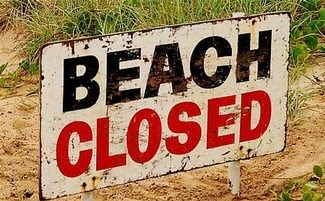
Showing posts with label Beach Closures. Show all posts

Thursday, June 20, 2013

Groups File Notice of Intent to Sue EPA for Failure to Protect Beachgoers from Water Pollution

Press contact: Sean Dixon, Clean Ocean Action 732-872-0111, Policy@CleanOceanAction.org
                        Tina Posterli, Riverkeeper 516-526-9371, tposterli@riverkeeper.org
                        Matt King, Heal the Bay, 310-451-1500 ext. 137, mking@healthebay.org
                        Blair Fitzgibbon, Waterkeeper Alliance, 202-503-6141, Blair@fitzgibbonmedia.com


EPA’s new water quality criteria fail to protect human health as required by the BEACH Act.
NEW YORK, N.Y. (June 20, 2013) – The Environmental Protection Agency has failed to meet its legal responsibility to adopt water quality criteria that address the health threat posed by pollution at U.S. beaches, according to a notice of intent to sue filed by a coalition of local and national organizations concerned about beach water quality. The groups are Clean Ocean Action, Hackensack Riverkeeper, Heal the Bay, Natural Resources Defense Council, NY/NJ Baykeeper, Riverkeeper and Waterkeeper Alliance.

“Too many of America’s beaches are sick – and they’re passing on their illnesses to families across the country,” said Steve Fleischli, Water Program Director at the Natural Resources Defense Council. “But EPA is not doing its job to help make sure we are safe when our families head to the beach.”

More than 180 million people visit coastal and Great Lakes beaches every year, and swimming and surfing are favorite pastimes in the United States. But beach closings due to hazardous contamination remain near all-time highs. In 2011, there were over 23,000 beach closing and health advisory days across the country. More than two-thirds of the closing and advisory days were prompted by dangerously high bacteria levels, indicating the presence of human or animal waste. The underlying culprits are generally improperly treated sewage, animal manure and contaminated stormwater runoff, which have a highly deleterious effect on water quality.

This pollution poses a significant threat to public health. Pathogens in contaminated waters can cause a wide range of diseases – including gastroenteritis, dysentery, hepatitis, and respiratory illness. However, despite these risks, EPA’s latest actions fail to protect people who choose to recreate in coastal waters. EPA has estimated that up to 3.5 million people become ill annually from contact with either overflow of overburdened sewage treatment plants during storm events, leakage from faulty infrastructure, or inappropriate sewage treatment.

“A day at the beach should never make someone sick,” said Kirsten James, Science and Policy Director for Water Quality at Heal the Bay. “EPA missed a major opportunity and a legal mandate to upgrade its recreational water quality criteria to better protect the public from the dangers of polluted water at U.S. beaches. This must be corrected.”

In 2000, Congress enacted the Beaches Environmental Assessment and Coastal Health Act (BEACH Act), requiring EPA to modernize criteria for water quality that would protect beach users from illnesses caused by pathogens, such as viruses and bacteria. EPA updated these criteria in 2012. However, EPA’s 2012 criteria are inadequate and fail to protect public health in several ways:

  • EPA’s criteria fail to protect against single day exposures to pathogens. 
  • EPA now allows water quality samples to exceed contamination levels EPA has determined are unsafe up to 10% of the time without triggering a violation. This approach could mask a serious pollution problem and expose families to an unnecessary risk of illness from recreating in local waterways.
  • EPA’s new criteria also fail to address the risk of non-gastrointestinal illnesses – such as rash and ear infections – that result from recreating in contaminated waters. The agency concluded that addressing stomach illnesses would adequately protect the public from other types of ailments.
  • EPA’s criteria permit a level of risk that would result in 36 of every 1000 beachgoers becoming ill with vomiting, nausea, or stomachaches. This level of risk is unacceptably high.

“Swimmers deserve to know that their favorite beach is clean on the day they're using it. It doesn't matter to them one bit what the average water quality was a month ago,” said Captain Bill Sheehan, the Hackensack Riverkeeper. “New Jersey discharges 23 billion gallons of sewage per year from permitted sewer overflows. Sometimes our waters are clean, sometimes they are dangerous; we are not safe unless we know which is true on a daily basis.”

“The New York-New Jersey Harbor has seen both increasing recreational use and increasing impacts from disease causing pollution,” said Deborah A. Mans, the NY/NJ Baykeeper. “We need EPA to let people know when the water is safe and to punish polluters when it is not. A monthly standard just does not protect public health.”

“EPA’s criteria is doubly flawed because it not only assumes that is acceptable for 36 of every 1000 people to contract gastro-intestinal illness by recreating in contaminated water, an unacceptably high number; it also ignores the proven risk of other health impacts, from rashes to eye and ear infections that routinely plague swimmers in our waterways,” said Phillip Musegaas, Hudson River Program Director for Riverkeeper. “People recreating in the Hudson River must be protected with strict standards, utilizing the best science to truly protect public health rather than the EPA’s status quo.”

“Science-based criteria for pathogens in recreational waters are the cornerstone of the Clean Water Act’s protections against widespread pollution by animal manure and human sewage and are essential to protecting people that swim and fish in our nation’s waterways from pathogenic illness,” said Kelly Foster, Senior Attorney for Waterkeeper Alliance. “EPA has adopted criteria that do not protect the public from disease when swimming and fishing, make it more difficult to reduce or eliminate pathogens from our recreational waters, and do not adequately inform the public about the risk they face when deciding to go to the beach. Without adequate recreational criteria, the Clean Water Act simply cannot function to adequately protect us from disease when swimming at our nation’s beaches and recreational waters.”

“The beaches, boardwalks, and bays of the nation drive billion-dollar coastal economies,” said Cindy Zipf, Executive Director of Clean Ocean Action, “having clean, safe beaches where parents, children, tourists, locals, surfers, and fishermen can enjoy a day at the beach without a day at the doctor’s is the keystone condition for these clean coastal economies. The EPA has failed in its duty to protect beachgoers using the best science, and has failed to develop a system that warns the public of health risks before they happen – not several days or weeks later.”

###

Clean Ocean Action is a coalition-based non-profit organization working to improve and protect the water quality of the marine waters off the New Jersey and New York coasts. Follow us @CleanOcean or online through www.CleanOceanAction.org

Hackensack Riverkeeper is a non-profit corporation organized to provide representation for the living resources of the Hackensack River. Hackensack Riverkeeper runs boat tours and operates a paddling center on the Hackensack River in the Meadowlands, and has its offices in Hackensack New Jersey. Captain Bill Sheehan founded Hackensack Riverkeeper fifteen years ago. www.hackensackriverkeeper.org

Heal the Bay is a non-profit organization dedicated to preserving Santa Monica Bay and all southern California coastal waters and watersheds. Progress toward the mission is achieved by effectively combining the use of science, advocacy, community outreach, and public education to create positive environmental change. For over two decades, Heal the Bay has been effective in cleaning up polluted waterbodies, including freshwater and coastal waters, to better protect the health of the public and aquatic life throughout the Los Angeles region. www.healthebay.org

The Natural Resources Defense Council (NRDC) is an international nonprofit environmental organization with more than 1.4 million members and online activists. Since 1970, our lawyers, scientists, and other environmental specialists have worked to protect the world's natural resources, public health, and the environment. NRDC has offices in New York City, Washington, D.C., Los Angeles, San Francisco, Chicago, Livingston, Montana, and Beijing. Visit us at www.nrdc.org and follow us on Twitter @NRDC.

NY/NJ Baykeeper is a non-profit corporation working to protect, preserve, and restore the ecological integrity and productivity of the New York/ New Jersey Bay. Baykeeper conducts restoration programs, especially oyster restoration, in both New York and New Jersey waters, works to acquire land for preservation and advocates for clean water throughout its coverage area – extending from Sandy Hook, New Jersey through Jamaica Bay Queens. Debbie Mans is the NY/NJ Baykeeper. http://nynjbaykeeper.org/

Riverkeeper is a membership-based, non-profit group dedicated to defending the Hudson River and its tributaries and protecting the drinking water supply of New York City and Hudson Valley residents. Through enforcement, grassroots advocacy and policy initiatives Riverkeeper has helped to establish globally recognized standards for waterway and watershed protection, and serves as the model for the growing Waterkeeper movement that includes nearly 200 Keeper programs across the country and around the globe. For more information please go to www.riverkeeper.org

Waterkeeper Alliance is an international alliance of water advocates working to patrol and protect rivers, streams, and coastlines around the world. Waterkeeper Alliance represents the interests of over 200 member watershed organizations providing a way for communities to stand up for their right to clean water. Visit us at http://www.waterkeeper.org and follow us on Twitter @Waterkeeper.

Monday, September 17, 2012

Wall Township Environmental Summit 2012

With the exception of the new makeup and legislators for New Jersey's 30th Legislative District, this year's Wall Township Environmental Summit was very similar in content to last year's.  What environmental issue is most concerning to the residents in District 30?  Wreck Pond.

A photo showing a nearby street after Wreck Pond flooded last year in the wake of Hurricane Irene.  Photo courtesy of Shelly Banjo for the Wall Street Journal
Senator Robert Singer, who's district previously spanned more of Ocean County, but is no stranger to representing coastal constituents, and Assemblyman David Rible were on hand to patiently listen to and address their constituents' concerns.  

The evening was kicked off by members of the Wreck Pond Homeowners Alliance, who went into detail about issues concerning the pond, stormwater management, flooding of their homes and associated health concerns, as well as the breakthroughs and shortcomings that they have had in dealing with the county, the state, and the federal government.  Asm. Rible stressed that both he and Asm. Sean Kean (also of District 30) were working closely with the DEP and Congressman Chris Smith's office on the issue.  "This time next year, we are not going to have this problem," offered Senator Singer to a round of applause, adding that he's not one to deem any task "impossible."

Fortunately, the NJDEP Action Plan that COA called for last year continues to be implemented. See here for more information. 

Clean Ocean Action was in attendance and echoed the concerns of the Wreck Pond Homeowners Alliance, but also brought a few additional issues up briefly.  With the looming cuts to federal programs that test water quality at swimming beaches, we asked the District 30 legislators to work with the DEP to ensure that funding for testing programs continues and that additional funding for storm event testing and source tracking is maintained. 

We also took the opportunity to provide information on the Tour for the Shore and the Clean Ocean Zone to Sen. Singer and Asm. Rible, keeping in mind that a number of towns in District 30 including, Point Pleasant, Howell, Manasquan, Lakewood, Bradley, Spring Lake, Belmar, Brielle, and Wall are already supportive.  We urged Senator Singer to co-sponsor a state-wide resolution in the NJ Senate supporting the COZ, while urging Asm. Rible to do the same in the Assembly.

Wednesday, June 27, 2012

NJ Beaches: Highlighting NJ 2011 Beach Testing Results

Seventh Avenue Beach in Belmar was the highest
ranked beach in New Jersey by NRDC.

While beach-goers hit the nation’s beaches to beat the heat, a report shows serious public health risks and problems with the health of beach water in New Jersey and across the nation.  NRDC’s 22nd annual report – Testing the Waters: A Guide to Water Quality at Vacation Beaches – analyzes government data on beach water testing results at thousands of beaches from 2011. 

The report confirms that last year, our nation’s beach water continued to suffer from serious contamination – including oil and human and animal waste – and a concerted effort to control future pollution is required.  At the same time, proposed federal and state actions will eviscerate testing programs and leave citizens vulnerable to sewage exposure.

Beach Testing Findings – 2011:   

Nationally:
  • There were 23,481 closing and advisory days at America’s beaches, including 2,344 due to BP oil spill.
  • Water quality at  beaches remained largely steady, with 8 percent of beach water samples nationwide exceeding public health standards in 2011 and 2010, compared to 7 percent in the previous four years.
  •  Most of closing and advisory days nationwide were issued because testing revealed indicator bacteria levels in the water that exceeded health standards  (more than one source reported for some events):
    • 47% were attributed to stormwater runoff
    • 49 % unknown
    • 12% miscellaneous including wildlife
    • 6% were due to sewage spills and overflows 

In New Jersey:
  • New Jersey ranked 4th in the nation (out of 30 states) for cleanest beaches based on number of samples exceeding national standards in 2011 (lowest to highest).
  • 226 ocean and bay beaches were tested
  • 132 closing and advisory days last year, an increase from 109 in 2011.  There was a 29% increase in the number of closings alone.  There would be more if all counties posted advisories for single samples.
  •  Only Monmouth County posted advisories at the beach and DEP posted them online for exceedances.
  • 17% (23) of closing/advisory days last year were due to elevated bacteria levels,
  •  5% (6) were due to advisories issued for a sewage spill or overflowing manhole
  • 79% (103) were preemptive,i.e., without waiting for monitoring results due to rainfall and known problems with bacterial levels.  
  • 3% of samples exceeded the standard, an increase  from 2%  in 2010.  

Pollution in recreational waters nationwide causes a range of waterborne illnesses in swimmers including stomach flu, skin rashes, eye, ear, nose and throat infections, diarrhea, and other serious health problems.  There are areas with persistent pollution that need to be investigated and sources that need to be  cleaned up.

EPA has proposed to cut funding for the entire National Beach Monitoring Program.  Fortunately, Congressional ocean champions, including Senators Lautenberg and Menendez and Representative Pallone, have responded and are working to ensure that funds are fully reinstated in the budget.  Our groups strongly support their efforts.   The 2000 Beaches Environmental Assessment and Coastal Health Act (BEACH Act) needs to be reauthorized.  Since 2000, New Jersey Congressional leaders have sponsored this act.

In NJ, the Department of Health and Senior Services  has responsibility to update the public recreational bathing rules.  However despite efforts and participation by COA and others, changes to improve these rules have not moved forward.  Action by NJDHSS is overdue. 

In New Jersey, there are statewide needs for improved stormwater management and funding to repair old and aging infrastructure.  Polluted run-off from overdevelopment remains the largest source of beach closures. 


How YOU Can Take Action:
  • Thank your Congressional ocean champions, like Senators Lautenberg and Menendez and Representative Pallone for working to reinstate beach testing programs funding in the budget!
  • Read the full press release from our press conference today here

Tuesday, June 26, 2012

NJ BEACHES MIXED REVIEWS AND UNCERTAIN FUTURE


MEDIA ALERT

For Immediate Release: June 26, 2012

CONTACT: Lindsay McNamara, Clean Ocean Action
732-872-0111 (office), 908 310 6729 (cell)

NJ BEACHES MIXED REVIEWS AND UNCERTAIN FUTURE

Groups Review Threats to BEACH Program and
 Highlight NJ results in Water Quality Report


WHO:       Clean Ocean Action, Environment New Jersey, Surfrider Foundation, Surfers’ Environmental Alliance, NY/NJ Baykeeper, Alliance for a Living Ocean; also invited are representatives from the office of US Representative Frank Pallone, Jr. (D-6) and Mayor of Sea Bright Dina Long.

WHAT:     Groups call on Congress to stop proposed cuts to the national BEACH monitoring program funding. The New Jersey review of the 22th annual national report by Natural Resources Defense Council “Testing the Waters: A Guide to Beach Water Quality at Vacation Beaches.” Groups to highlight state and local water quality problems and call for national and local solutions.

WHEN:     Wednesday, June 27, 2012, 11 A.M.

WHERE:   Sea Bright Boardwalk Pavilion, Sea Bright, NJ

WHY:        Pollution continues to cause closures of NJ beaches.  Passage of strong federal legislation to reauthorize the BEACH Act is needed to increase public protection and improve water quality.  New Jersey also still needs to update old bathing rules and reduce pollution sources.

PHOTO OPS:  Beach location; ocean/bay views; people swimming and enjoying the ocean and beach

DIRECTIONS:

From north, take Garden State Parkway south to Exit 117 (Keyport) 36.  Take Rt. 36 East/South toward Sandy Hook for about 12 miles.  Cross the Highlands Bridge, stay left and follow Rt. 36 south into Sea Bright.  Turn left into parking lot near library. 

From south, take 36 West/North toward Sandy Hook.  When road ends, take a left on to Ocean Avenue.  Follow Ocean Avenue north approximately 3.4 miles to Sea Bright.  Turn right into parking lot near library across from River Street.   

Event at green and white tented pavilion in south east corner of parking lot behind the firehouse/police station. 


Friday, June 22, 2012

Beaches Marred By Garbage Wash-up


On Saturday, June 16, beaches from Barnegat Light all the way to Ship Bottom, including Long Beach Island, were closed after a large amount of debris washed up along the shore.  About 50 syringes were found in the wash-up of trash and marine grass on Long Beach Island alone.  The trash came from combined sewage overflows (CSOs) in the New York Harbor area.  When heavy rain events occur, antiquated sewage pipes cannot handle the combination of sewage and rainfall, causing CSOs.  What is flushed down the toilet then ends up in our waterways and ultimately our ocean.  The waste was cleaned up and beaches were reopened on Sunday, June 17.  Here are links to a few of the news stories featuring the wash up:


Clean Ocean Action would like to thank Congressman Runyan for sending a letter to EPA Administrator Lisa Jackson on Wednesday, June 20, concerning the syringes found on LBI.  Congressman Runyan cited New Jersey’s reliance on coastal tourism, stating in his letter that:

“New Jersey’s coastal communities and economies rely upon a strong tourism industry in order to thrive.  During the summer months this becomes even more prevalent, as even a day of closed beaches has a ripple effect that impacts the entire coastal economy.” 

To read the rest of Congressman Runyan’s letter, click here.  At COA, we applaud Congressman Runyan for speaking out for the ocean, our economy and our communities.

To highlight the state of public health protections at Jersey shore’s beaches, in response to recent events, Clean Ocean Action will hold a press event next Wednesday, June 27, location to be determined.  The event will focus on issues with tracking pollution sources at the state and federal level, as well as what citizens can (and have been) doing to keep beaches safe and swimmable.

Be sure to check Clean Ocean Action’s new blog tab “Beach Closing Updates” for the latest closure information throughout the summer.


Want to get involved?  Here are a few things you can do:
  • Write a letter to your representatives explaining your concern for public health protections at New Jersey beaches.
  • Call elected officials and ask them to support A2852 (in the Assembly) or S831 (in the Senate), a bill which would establish notification requirements for combined sewer overflows.
    • New York State has already passed CSO Right to Know laws that are waiting for a signature from the Governor (see here and here). 
  • Call COA if  you have any further questions.
  • Ask congress to continue to support beach water testing programs through the US BEACH Act!

Monday, March 5, 2012

NOAA Lab, Beaches, Etc

Over the last few weeks, Clean Ocean Action has been working on a variety of issues - from National Ocean Policy to your local beaches.

Today, we thought we'd share a few links to stories and webpages that we access as part of these ongoing battles for a clean ocean economy:


Last week, a number of news stories on COA issues were published:
  1. A COA letter to the editor was featured on NJ.com wherein we talk about three looming threats to the ocean (the same threats featured in this blog post),
  2. A story on Marine Mammal Stranding Fund Cuts was posted in the APP based on the NOAA budget issues we've been working on, and 
  3. A story was posted on the NOAA Fisheries Lab Closure at Sandy Hook and COA efforts to save it also in the APP, and another in the Philly Inquirer.
For many of these action items, and a few more, we use these websites regularly:
  1. The New Jersey Department of Environmental Protection (DEP) "transformation portal" where the DEP posts the times (and results of) for its stakeholder meetings on various state environmental initiatives.  Free and open to the public (unless otherwise posted as RSVP only) - so come out and speak up!
  2. The NJ DEP Barnegat Bay Program website - hosting the DEP's action items on Barnegat Bay action items
  3. The EPA's "beach program" site - the site for all info on the program whereby your beaches and swimming waters are tested to make sure it's safe to swim...and the program that the EPA proposes cutting
  4. The James J. Howard Marine Lab at Sandy Hook - proposed to be closed at the end of the year, this site details why it's important that this lab stay open
  5. The White House's National Ocean Council page where the administration's ocean policy initiatives can all be learned about in great detail.
  6. For offshore energy, we monitor the Bureau of Ocean Energy Management's website (www.boem.gov) and the two state-specific sites for New York and New Jersey on those states' federal renewable energy issues.
In one last shameless plug, other sites we love are the COA homepage, COA Blog, and COA Facebook page... 


Friday, February 17, 2012

Three New* Threats to Our Ocean


Recently, three new programmatic changes at the federal level are threatening our clean ocean economy and clean ocean zone.

1. EPA To Cut Clean Beach Programs

First, in a shocking turn of events, the EPA announced that, in President Obama’s 2013 EPA budget, they will no longer be implementing the “Beaches Program” or issuing Beaches Program grants to states.

The Beaches Program, under the Clean Water Act and the “BEACH Act” is a program at the EPA for protecting the health of swimmers and beachgoers from sewage and pollution risks.

Each year, in furtherance of these goals, the EPA works on:
  • promoting recreational water quality programs nationwide,
  • creating scientific improvements that support timely recreational water monitoring and reporting,
  • issuing grants (~$10 million in 2012) to eligible coastal states to develop and implement beach monitoring and notification programs,
  • publishing an annual Beach Notification Summary, giving information on beach water quality monitoring, beach advisories and closings, pollution sources, and state and local beach program contacts to the public, and
  • developing new or revised recreational water criteria for the most up-to-date protection of public health.
Unfortunately, the President’s EPA budget proposes ending this program:


“To help meet the fiscal challenges of FY 2013, the EPA has reviewed its programs for areas where any potential efficiencies and streamlining can yield savings and is eliminating the Beach Program.”

The report continues:

“While beach monitoring continues to be important to protect human health and especially sensitive individuals, … [n]o additional funding will be provided for the following: (1) implementing monitoring and notification programs consistent with the EPA’s National Beach Guidance and Required Performance Criteria for Grants and (2) submitting monitoring and advisory data to the EPA so that the Agency can provide this information to the public in a timely and easily accessible manner.”

The EPA says that the Beach Program has accomplished it’s mission, yet without the program, many states will have no resources for any swimmer-safety tests, states will be free to adopt lax standards (or end testing altogether because they are no longer held to a federal regulatory “floor”), and, by and large, the public health will be put at risk.

Please call your elected officials and ask them to stand up for swimmer safety by re-authorizing this program to give states the science and tools they need!

2. Renewed Atlantic Ocean Oil Drilling Push in the House – H.R. 7

Second, the House of Representatives yesterday passed a bill which opens up the Atlantic Ocean to oil drilling – as soon as this year!  The bill, a floor-modified version of HR 3408, requires that a large portion of the ocean off of the coast of Virginia be opened for drilling almost immediately, and that the rest of the Atlantic Ocean be considered open for business as well.

When this bill was being debated in Committee (before hitting the House floor), New Jersey Representatives Pallone, Holt, and Runyan all voted against the bill (roll call votes). 

Once the bill hit the House floor, one amendment was proposed that would ban drilling in any ocean areas that would “affect” New York or New Jersey  - essentially banning drilling in Virginia and points south in the Atlantic.  In the vote on the amendment, 5 of New Jersey’s 6 Republican Representatives voted to pass it (Mr. Garrett was the lone NJ Congressman voting against this ocean-protection amendment), standing with the united Democratic NJ Delegation in defense of the shore.   

For 50 years, members of Congress from both sides of the aisle have fought to keep the Atlantic Ocean off-limits from oil drilling. With yesterday’s vote, it is clear that this long-standing support is eroding, but in New Jersey, our elected officials know that a clean ocean economy is a non-partisan issue – it is too essential to the people, communities, and businesses of the Shore. 

We thank the 8 NJ and 19 NY Representatives who voted against this bill (see Floor Vote, Roll #71), but urge you to call your elected officials (Senators, Congressmen, State Officials) and ask them to take every step they can to see that the opening of the Atlantic Ocean to oil drilling doesn’t happen. 

3. Proposed Closure of the NOAA Fisheries Service James  J. Howard  Marine Sciences Laboratory on Sandy Hook

Third, President Obama announced in the budget proposal for the National Oceanic and Atmospheric Administration that the James J. Howard Fisheries Lab on Sandy Hook will be closed – one year after its 50th anniversary celebration. 

The decision to close this lab could not have been made at a more inopportune time.  Our oceans, and the Mid-Atlantic Ocean this lab directly adjoins, are changing.  For the first time in decades, there may be oil drilling in the Mid-Atlantic Ocean, most notably in Virginia.  Your Department of Interior recently announced lease availability for over 800 square miles of the Mid-Atlantic Ocean.  The shores of this region are the most densely populated in the nation.  The fisheries, tourism, and recreation value of the Mid-Atlantic Ocean is nearly incalculable.  Algal blooms, sewage spills, sedimentation, and the science of managing the Port of New York all fall within the scientific ambit of this region. 

The research undertaken at the Howard Lab on these issues, and on ocean acidification and climate change impacts to marine ecosystems, are the foundation upon which informed decisionmaking is built. Indeed, this lab was recently recognized by NOAA leadership as the premier state-of-the-art facility for conducting ocean acidification research on the East Coast.  Moreover, research conducted at the lab is instrumental in ongoing planning efforts for the siting of the first offshore wind facilities in the United States – a priority for your Administration.

Senators Lautenberg and Menendez, with Congressman Pallone pledged to prevent the closing of the Lab in a letter sent directly to the President


###

To find out how you can help on any of these issues, contact the Clean Ocean Action office at 732-872-0111 and ask for Zach, or email citizens@cleanoceanaction.org.

Monday, August 22, 2011

Beach Closures: Monday August 22, 2011

Headed to the beach? 
The following are closed:

OCEAN BEACH CLOSINGS: Brown and York Avenue beaches in Spring Lake and the Terrace and Beacon Blvd. beaches in Sea Girt are closed today as a precaution due to rainfall and the resulting stormwater discharge from Wreck Pond.

RIVER/BAY BEACH CLOSING: L Street river beach in Belmar and the Shark River Beach and Yacht Club in Neptune are closed today as a precaution due to rainfall and the resulting stormwater discharge.

All other lifeguarded beaches are open today.

For more information, visit:

Monday, August 15, 2011

Safe To Swim?

Headed to the beach?  Here's what you should know.

OCEAN BEACH CLOSINGS:

Brown and York Avenue beaches in Spring Lake and the Terrace and Beacon Blvd. beaches in Sea Girt are closed today as a precaution due to rainfall and the resulting stormwater discharge from Wreck Pond.

RIVER/BAY BEACH CLOSINGS:

L Street River beach in Belmar and the Shark River Beach and Yacht Club in Neptune are closed today as a precaution due to rainfall and the resulting stormwater discharge

Test results from most beaches will not be available until tomorrow.

Health advisories have been posted for 3 of the 4 beaches tested in Ocean County where the rapid test which provides same day results is being used as part of a pilot program.  Windward Beach in Brick, Avon Road in Pine Beach, Beachwood Beach West in Beachwood all had exceeded the health threshold using the new test method.  Angelsea in Ocean Gate had one sample above and one below this level and was stated as having an undetermined result. Confirmation samples using the traditional method will be available tomorrow.

You can find the most up-to-date information on beach closings here: http://njbeaches.org/


Clean Beaches, Healthy Swimmers

Clean Ocean Action’s notes on healthy summer swimming on the Shore

Recently, news outlets have been reporting on the adequacy and timeliness of beach water quality monitoring – the vital service funded by the NJ Department of Environmental Protection to close beaches if unsafe levels of bacterial contamination are detected. Read one such story here.

Basically, the way the program works is that NJ County and State water scientists head to the beaches every Monday morning and take a water sample.  Testing on that sample takes up to 24 hours.  If the sample shows that there is too much bacteria in the water, two things happen: first, an advisory is issued at the beach that warns people of the issue, and second, another sample of water is taken.

After the second sample is collected, which is generally Tuesday afternoon, the DEP closes the beach (again, up to 24 hours later) and takes daily (or more) samples until the bacteria level falls back into compliance.

The EPA and the DEP are working on a 3-hour test method (instead of 24 hours) in order to get advisories and closures to swimmers as quickly as possible.  Clean Ocean Action is working with our NJ Congressmen and Senators to get a law passed in Congress to mandate that this quick-test method be implemented nation-wide, and that there is enough funding to keep our beachgoers  safe. 


In some of the most egregious cases, the DEP and the counties will work to track the source of the bacteria.  Sometimes, however, the source is well-known: rainfall overtaxes our aging infrastructure and sewage leaks from pipes, stormwater systems, and back estuaries. 

Last year, due to an unusually dry summer locally, New Jersey’s shores were the second most bacteria-free beaches in the nation – behind only New Hampshire (with its whopping 13 miles of beaches). 

This year, there have been a few instances of beach closures, mainly in Ocean and Monmouth County.  If you want to track these closures, and see first-hand the test results for your favorite beach, click here:

Monmouth County (by day), (by week)
Ocean County (by week)
Atlantic County (by week)
Cape May County (by week)


If you’re in a rush to get to the beach and don’t have the internet, give 1 (800) 648-SAND a call and the same information (on which beaches, if any, are closed) will be on the automated machine you hear…