Showing posts with label NJDEP. Show all posts

Thursday, February 2, 2017

Dredging and Beneficial Use - Part 2: Shark River Dredging Project

Introduction
For over 30 years, Clean Ocean Action has worked to review, develop, and advocate for community driven dredged material management solutions. By viewing dredged material as a resource, and emphasizing community input and engagement, COA has reviewed and identified potential beneficial use options for dredged material placement in many different contexts and uses. Above all, throughout this process, COA has advocated for environmental protection, and community involvement and support as key tenets of our position. As we say here at Clean Ocean Action, “we know mud”.
This is part two of our series on the beneficial use of dredged material.
SHARK RIVER - Critical Navigation, Innovative Dewatering, and Beneficial Use


The Shark River is a tidal estuary bordered by five towns - Neptune Township, Neptune City, Avon, Belmar and Wall Township. The river is popular for stand up and kayak paddling and bird watching, as well as safe harbor for hundreds of commercial and recreational fishing and pleasure boats. The marinas surrounding the river have also become a focus of redevelopment with bars and restaurants flanking these marina hubs. For over two decades, critical dredging of channels was needed to allow the passage of vessels into and out of the estuary. However, no satisfactory location was available to place the estimated 102,000 cubic yards of dredged material. In fact, the old CDF for Shark River is actually the site of the Seaview at Shark River Island condominium community; a clear example of the lack of open space in the area. Everyone agreed that the river needed to be dredged, but there was no consensus as to where the material could be placed, or even dewatered for transport. An innovative solution was necessary to get this project off the ground.

Enter a dedicated coalition of State, County and local leaders that effectively advocated for the project, including Senator Jen Beck, Committeeman Randy Bishop, County of Monmouth, Board of Chosen Freeholders, New Jersey Department of Transportation (NJ DOT) Office of Maritime Resources, New Jersey Department of Environmental Protection (NJ DEP), and the governing bodies of the participating municipalities including Neptune City, Neptune, Belmar, and Wall. Recognition must also go to the Shark River Cleanup Coalition, who has been advocating for the dredging of the Shark River for many years now. 

NJDOT put a concept and "workable plan" out to bid. Mobile Dredging and Pumping Co., out of Chester, PA. Mobile Dredging was awarded the $7.6 million contract in the summer of 2015, as the responsible low cost bidder for the project, and with coordination from NJDOT and NJDEP, a workable solution was created that used innovative technology to dewater the dredged material slurry on a very small footprint surrounded by homes, businesses, and marinas, before trucking it to the Monmouth County Reclamation Center for use as landfill cover. The project removed approximately 102,000 cubic yards of sediment from the River comprised of sand and silt using hydraulic dredging, and then piped the slurry via a secure welded pipeline to the selected dewatering location.

Caption: far off in the Shark River, the hydraulic dredge removes sediment to improve navigation (photo courtesy of Cindy Zipf).
The dredging had started late last fall and was halted on January 1, 2016, due to state regulations in place to protect spawning and the early life stages of winter flounder and anadromous fish. During this initial phase of the project, “geotubes” were used to dewater the slurry before trucking the material off to be used. Geotubes are large fabric bags that the slurry is pumped into, with pressure forcing the water out of the bag while the sediment remains.
Caption: this image shows the piping system that moves the dredge slurry to the dewatering site, as well as the pipe that takes the water that has been removed out of the sediment and returns it back to the river (photo courtesy of Cindy Zipf).

Caption:  dredge slurry is pumped into the geotube. The fabric is designed to let water escape, leaving behind the sediment for removal and use as cover at a landfill.


When the project was restarted in July, the dewatering process was changed to handle larger amounts of material and get the project done before the dredge window closed.

Caption: a first look at the dewatering site. (video courtesy of Cindy Zipf).


This dewatering process is called “mechanical dewatering” and utilizes transportable and modular centrifuges and belt presses to separate usable sand out of the finer sediment, then mechanically squeeze the water out of the slurry. The process is rather impressive to behold, and when up and running, is able to process a huge amount of material on a very small footprint – perfect for the heavily built up mid-Atlantic coastline.
Let’s walk through the process:


First, a hydraulic dredge removed sediment in a slurry that is piped to the dewatering location. This pipe runs to a large tank that slows down the flow of water and allows larger pieces of debris to settle out.

Caption: Rick, from Clean Ocean Action, talks to the contractor supervisor in front of one of the large tanks where the dredge slurry is first pumped to (photo courtesy of Cindy Zipf).
The slurry is then pumped into several centrifuge and screen type machines, that are able to sort out debris and coarse sand sediments from the muds and silts. These machines are also able to remove large amounts of debris and trash from the sediment as well. The idea is that the larger pieces of debris and sand can actually harm the belt presses which squeeze the water out, so removing them on the front end of this process saves those machines, and also allows for use of sand! This project produced about 500 cubic yards of sand that was trucked and placed on the Township of Neptune’s beaches.

Caption: Bill from NJDOT shows us the centrifuge systems which remove the larger sediments and debris on the front end of this process (photo courtesy of Cindy Zipf).


Caption: The centrifuges are able to remove debris and shell fragments which are removed from river and properly disposed of (photos courtesy of Cindy Zipf).


 Caption: Zach from COA inspects the sand removed off of the front end this process - over 90% sand = perfect for beach placement (photo courtesy of Cindy Zipf).

The slurry then travels to belt presses which wring the water out of the slurry and extrude a dredge material “brownie” (photo courtesy of Cindy Zipf)..
Caption:  the mechanical dewatering process in a series of videos (courtesy of Cindy Zipf).

1. After having larger sediment and debris removed, a polymer is added to the slurry and then spread out onto the fabric conveyor belts

2. The conveyor belts transport the slurry through a series of belt presses, which mechanically squeeze the water out of the material. This process occurs several times. Water from this process is treated and sent back into the Shark River.


3. The dredge material, now dewatered, is extruded out of the belt presses.


Caption: the result of this dewatering process is a sediment "brownie" that has been wrung dry, and easily transportable (photo courtesy of Cindy Zipf).


This material is then scooped up and put in a holding area, where dump trucks then take it to the Monmouth County Reclamation center, where it will be mixed with sand and used as landfill cover (photo courtesy of Cindy Zipf).
The Shark River project is a great example of coupling an innovative dewatering process with beneficial use of the material, in order to meet the constrains of the project. The mechanical dewatering process took up about an acre of area, was self contained and rather unobtrusive to the surrounding area, and allowed sand to be harvested off the front end for beach placement, and sediment off the back end for landfill cover (photo courtesy of Cindy Zipf).

A final note: the footprint of one acre for dewatering was barely enough room to get this job done. A larger footprint for dewatering would have made the project less expensive and faster to complete. Furthermore, Monmouth County Landfill accepting the material for free was a key in making this project feasible. This all goes to show that finding large scale, affordable, beneficial use opportunities is really challenging - and cooperation and coordination between all entities is absolutely essential to the success of these types of projects.


Thursday, January 26, 2017

Dredging and Beneficial Use - Part 1: Manasquan Inlet


1

Introduction
For over 30 years, Clean Ocean Action has worked to review, develop, and advocate for community driven dredged material management solutions. By viewing dredged material as a resource, and emphasizing community input and engagement, COA has reviewed and identified potential beneficial use options for dredged material placement in many different contexts and uses. Above all, throughout this process, COA has advocated for environmental protection, and community involvement and support as key tenets of our position. As we say here at Clean Ocean Action, “we know mud”.

In the last several years, we have been monitoring what many call a “dredge crisis” – thousands of cubic yards of dredge material are waiting to be dredged out of critical navigational channels, however, without proper planning and community engagement, and the use of innovative technologies, the disposal options for all of this dredged material is limited. Without a plan to deal with all of this dredged material, these projects are put on hold; in some cases, for decades.

Traditionally, Confined Disposal Facilities (CDFs) were used as both temporary and final disposal locations for this material. CDFs are engineered structures designed to provide storage for the soupy mix of suspended solids that are dredged out of channels and pumped into them. These structures traditionally appear as the familiar hills and berms that you may see rising out of the wetlands in many locations. In general, these CDFs can fill up rather quickly, are expensive to continually maintain, and many of these CDFs have fallen into disrepair over the years, further limiting disposal options.

Today, there are many solutions for clean dredge material placement including beneficial use options such as using the sediment in construction fill or cover for landfills (for contaminated dredge material the options are rightfully more limited). However, for these uses, the soupy, watery dredged material must be “dewatered” so that it can be transportable and useful. Most dewatering methods involve the use of a CDF, the construction of temporary CDFs on land to dewater the material before trucking it off, or even the use of other technologies to dewater the material in short amounts of time and on increasingly smaller footprints.

Furthermore, there are methods that can beneficially use dredged material without dewatering. Methods have been continually perfected to perform habitat restoration projects through the creation of “living shorelines” and the “thin layer placement” of material on a drowning marsh, and for the right types of material, can be pumped onto bayside and ocean beaches to fortify erosion areas and safeguard communities from storms.

COA recently visited two separate locations where innovative dewatering and placement methods have resulted in projects that provide benefits to boaters on the water, communities on land, and beneficial material for a multitude of uses.

Manasquan Inlet – Channel Dredging, Beach Placement and Erosion Control


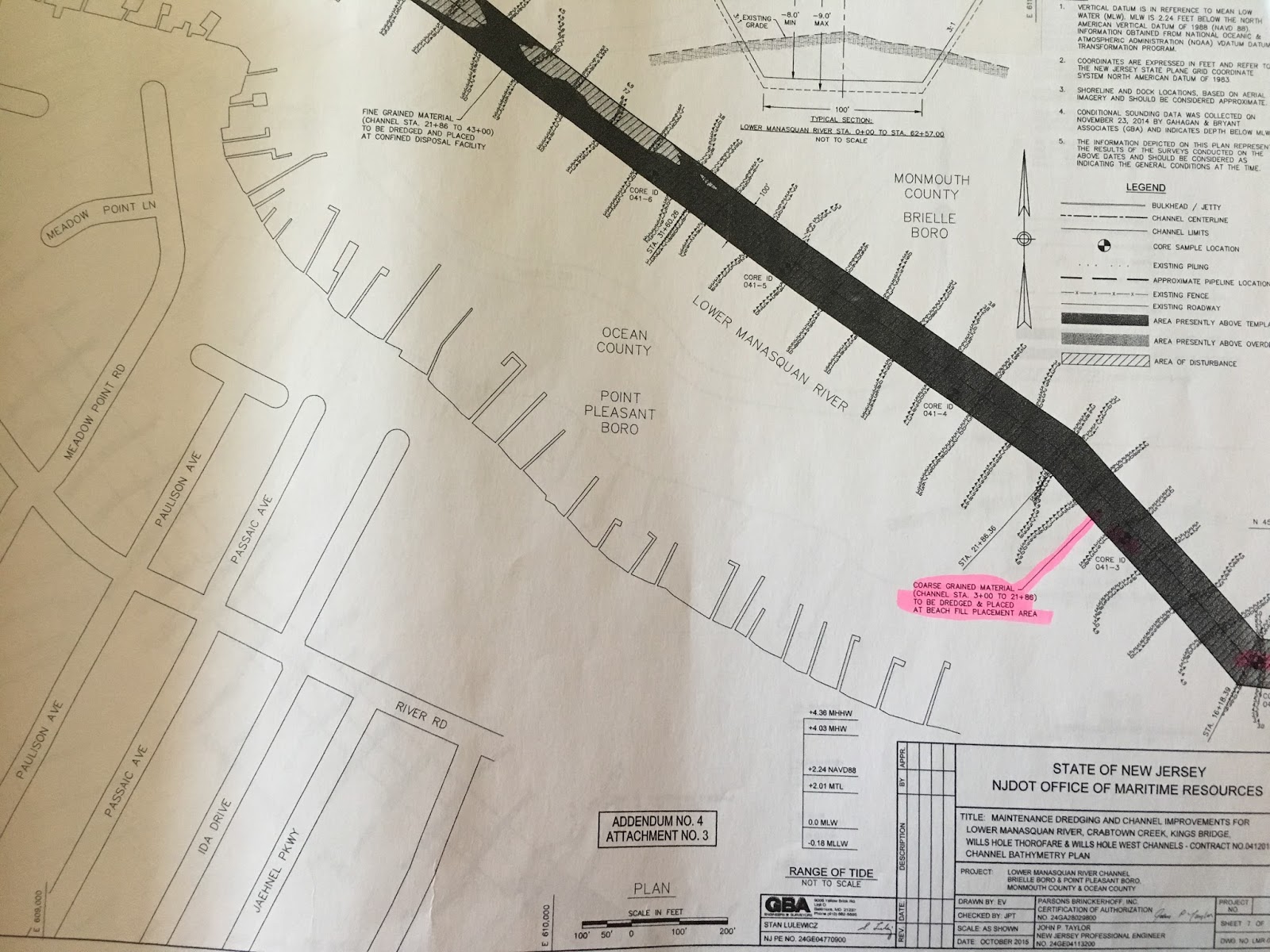
The Manasquan Inlet dredging project was permitted and put out to bid in the fall of 2015. The project permitted the dredging of the Lower Manasquan River Channel, Crabtown Creek Channel, Kings Bridge Channel, Wills Hole Thorofare, and Wills Hole West Channel. In total, over 100,000 cubic yards of material were permitted to be removed from these navigation channels.

In New Jersey, only material that is 75% sand or greater is allowed to be placed on beaches. The State however goes a step beyond this and only places material that is 90% or greater sand on bathing beaches (ie lifeguarded beaches), and 75% or greater sand material may be placed on non-bathing beaches (for example a bayside beach without a lifeguard). This is important for two reasons: 1) grain size directly relates to sand quality, which is an important consideration for those residents and visitors who come to the Jersey Shore to recreate on our world renowned sand beaches. 2) 90% sand or greater is given a “pass” from further chemical analysis because NJDEP have determined that once material reaches 90% sand in grain size, that material no longer is a risk for contamination. Therefore once this material is determined to be 90% or greater sand, no further chemical analysis is required. 

A sediment grain size analysis evaluating core samples taken at lengths along the channels was conducted by NJ Department of Transportation and reviewed by NJDEP and COA.

Roughly 57,000 cubic yards of sediment from the channels was found to be less than 90% sand - fine grained mud and silt. Gull Island is a CDF that sits smack in the middle of the river, and was designated and permitted as the receptacle for the majority of the fine grained material.

Caption: Gull Island CDF elevation map - a "bowl" for the fine grained dredge slurry (courtesy of Jersey Shore Drone)


However, approximately, 47,500 cubic yards of dredged material in specific locations of the Lower Manasquan Channel and Wills Hole Thorofare were found to contain 90% sand or greater, and  therefore suitable for placement on the beach between Manasquan Jetty and Brielle Road. This area of the beach was replenished by a larger federally overseen project in the past, however due to ocean currents and storms, is prone to erosion. Placing appropriate sand from the dredging project directly onto the beach helps to supplement and fortify the beach at this erosion prone area, and saves time, money and space for this dredging project, and future dredge and beach nourishment projects.

Caption: dredging Wills Hole Thoroughfare next to Gull Island CDF (photos courtesy of Jersey Shore Drone):

Sand that has been in the bays for several months, and even years, typically appear dark compared to sand that is found on the beach due to the presence of organic content from decaying vegetation and animals and the settling of these particles to the bay floor.  As this displaced sand dries and is exposed to sunlight and wave action, the dark organic material will weather and bleach out, and its color will change to resemble the color of sand that typically is found on New Jersey beaches.  This is similar to what we observe in typical beach replenishment projects in New Jersey: the sand that is pumped onto area beaches from the ocean and inlets is also dark when first placed on the beach, and then it lightens as it dries and is exposed to sunlight. The hydraulic dredging process may also pick up debris and trash that was buried in or sat on top of the sediment. 
Caption: 90% or greater sand with darker organic content that was pumped from Manasquan Channel and Wills Hole Thoroughfare directly onto the beach. Sunlight, rain, and wind action will eventually weather away  and wash out the darker organic matter leaving the lighter colored sand behind (photos courtesy of Jersey Shore Drone).

The site of a pipe on the beach releasing a dark colored slurry is an uncommon one for many people. However, when properly designed and vetted, these projects represent an innovative and beneficial use of material to protect properties and communities, save time and money, and perhaps contribute to less frequent large scale, federal beach nourishment projects that cost millions of dollars.

Caption: dredge slurry containing 90% or greater sand is pumped onto the Manasquan Beach, providing erosion control and protection from storms (photo courtesy Zach Lees):


It may not always be pretty -while there was some debris and trash picked up by the dredging process, the Borough of Manasquan worked in closely with NJDOT to utilize their beach rakes to remove this material, and with further coordination from the dredging contractor, ensured that larger items were captured prior to placement on the beach.


Caption: Borough of Manasquan raking the newly placed sand for any debris and shells that made it through the screens (photo courtesy Zach Lees).


Caption: Video taken by Jersey Shore Drones shows the Borough of Manasquan raking out any debris and spreading the newly placed sand out to weather out the darker organic material.


COA reviewed the permits and sediment analysis authorizing this project, and visited the beach placement site with NJ Department of Transportation (state agency in charge of state navigational channel dredging) and a representative from the Borough of Manasquan. The sediment analysis showed that each core sample was 90% or more sand, and that the dredged areas that were designated for beach placement were chosen with caution in mind, and a clear understanding of the value of New Jersey’s beautiful beaches. 


While the initial placement of this material may look a bit different than the surrounding sand, this is a temporary issue that will fade away with time, and this type of project is a model for the type of innovative beneficial use projects that can be designed to help move forward necessary navigational channel dredging, while also fortifying NJ’s beaches from storms and sea level rise.


NOTE: most all of the pictures we used of the Manasquan Channel dredging project, including the one below, are courtesy of Jersey Shore Drone, who has an incredible website that we highly recommend: http://www.jerseyshoredrone.com/2016/11/njdot-manasquan-river-dredging-11272016.html

Caption: a final shot by Jersey Shore Drone of the beach placement site. Note the "bump out" already provided by the project, in an area that was previously eroded.


[1] Credit to Jersey Shore Drone, who has done some incredible work visualizing and documenting many of these locations on the Jersey Shore. http://www.jerseyshoredrone.com/2016/04/nj-dot-manasquan-river-dredging-project.html

Tuesday, May 26, 2015

Senator Booker Urges NOAA Administrator to Withdraw Seismic IHA

US Senator Booker wrote to Dr. Sullivan, administrator of the National Oceanic and Atmospheric Association, formally requesting that the National Marine Fisheries Service withdraw the Incidental Harassment Authorization needed for the Rutgers seismic study to legally harass marine mammals and reopen the comment period so that concerned organizations and the public are given a meaningful opportunity to review this survey. Senator Booker cited the exponential increase in the number of marine mammals estimated to be harassed and the methodology used to calculate the new numbers as justification for withdrawal of the authorization and a reopening of the comment period. In addition, Senator Booker reiterated his support for the NJDEP’s concerns with the proposed project’s impact on New Jersey’s coastal resources and desire for the ongoing mediation process between the NJDEP and the National Science Foundation (as lead agency for this survey) to conclude before any permits are issued by NOAA.

Clean Ocean Action applauds Senator Booker’s close analysis of the proposed project and its impact on New Jersey’s marine life and economy and is looking forward to Dr. Sullivan’s response.  

Thursday, June 12, 2014

One Fish, Two Fish, Dead Fish, Blue Fish

On the morning of May 12, thousands of dead menhaden or “bunker” fish washed from the Shark River as the tide went out, and littered nearby beaches.  Throughout the day, fish continued to drift from the inlet and wash-up on the shore, primarily in Avon and Belmar.   Early in the day, fishermen and local businesses reported the event, and the New Jersey Department of Environmental Protection and the Monmouth County Health Department collected water quality and fish tissue samples for examination.   

Though it is challenging to diagnose an issue after it actually occurs, scientific consensus is that the kill was a naturally occurring event.  Some thought that the warming temperatures and heavy rains throughout the week stirred up nutrients in the water, causing small algae to bloom.  When the algae dies, bacteria break it down, and this uses up much of the oxygen in the water, which can stress fish and shellfish.  High levels of algae were not found in the water column hours after the event, so others focused on the large size of the bunker school, and how they were chased into the shallows of the Shark River, where oxygen was likely lower than out in the ocean. The sheer number of skittish bunker moving around in a small area could have used up much of the oxygen through the overnight hours. Both of these situations are plausible explanations for a late spring fish kill, and both focus on the fish not being able to survive low oxygen levels.  

The public is often on the front line for spotting and reporting environmental health issues, whether dead fish, discolored water, algae blooms, or debris and medical waste. If you see anything unusual along a river, bay, beach, or in the ocean, call the NJ DEP hotline at 1-888-WARN-DEP. You should write down the report number, take photos of what you observe, and note the day, time, and water conditions.  

Tuesday, June 10, 2014

NJDEP Proposes Consolidation and Amendment of Rules Governing Coastal Development

The June 2 New Jersey Register contained a notice from the New Jersey Department of Environmental Protection (NJDEP) that the agency has proposed to consolidate the existing Coastal Permit Program Rules and Coastal Zone Management rules into one chapter and to make other changes on how development in coastal areas will be permitted in the future.

The proposed rules contain several components that appear to be beneficial for water quality, and also some troubling provisions.  For example, the definition of “dredged material” is modified so that it makes clear that it is not a solid waste under the Solid Waste rules.  This will enable increased beneficial use of dredged materials for beach protection, marsh creation, capping of contaminated soils or sediments, and other projects, as long as the material meets certain criteria.  On the other hand, provisions which will allow “permit by certification” for bulkhead reconstruction and recreational dock and pier construction in lagoons will streamline the process for homeowners and businesses, but eliminates much of the oversight on these types of projects, and fails to encourage natural living shorelines as alternatives.

COA is concerned that the proposed rule changes, which represent the first major overhaul of the coastal rules following Sandy, do not go far enough to address the threats that future climate change and sea level rise pose to our coastal areas – in fact, the phrases “climate change” and “sea level rise” are not mentioned even once in the over 1,000-page document released by the NJDEP.  The proposed rules also include provisions that encourage coastal development, including provisions that enable marina construction and expansion in certain areas of shellfish habitat and the construction of restaurants (non-water dependent uses) in certain new or existing marinas, which can cause increased litter in the marine environment.

A final public hearing will be held on Wednesday, July 9 at 11:00am at the Coastal Education Center of the Jacques Cousteau National Estuarine Research Reserve, located at 130 Great Bay Boulevard in Tuckerton.  Written comments may be submitted either electronically or via regular mail by August 1, 2014.  Visit www.nj.gov/dep/rules for the full proposal and information on how to submit comments.

Thursday, August 29, 2013

How Are The East Coast Dolphins Doing?

Photo Credit: NOAA
Clean Ocean Action continues to monitor the investigation of recent dolphin deaths off the coast of the Jersey Shore.  Please read our blog entries here and here from earlier this week and August 13, 2013 for more background information on the increase in dolphin deaths this summer.

In a USA Today story dated Tuesday, August 27, Todd Bates reported a total of 357 bottlenose dolphin deaths from early July through Monday August 26, 2013 from New York to North Carolina, according to federal officials. 

NOAA has determined that 32 of 33 dolphins tested from all five states are either suspected or confirmed positive for cetacean morbillivirus, a measles-like virus. For 11 samples, genetic sequencing has confirmed this finding.  Teri Rowles of the federal Marine Mammal Health and Stranding Response Program notes that the outbreak may last into next spring.  She says there is also a risk that the virus may be spreading to other marine mammal species, so researchers are looking into other deaths over the last six months.

“Since July 9, 74 dead or dying dolphins have washed up along New Jersey’s coastline. [Some] have been confirmed with morbillivirus,”according to Bob Schoelkopf, the Marine Mammal Stranding Center’s Executive Director. “[Others] have been tested for the virus, with results of those tests pending,” he said.

Ongoing investigations include the examination of other potential contributing factors, such as, pathogen, biotoxins, changes in habitat, etc.

Rowles added, “at this point, there isn't anything that we can do to stop the virus. We don't have a vaccine that is developed that could be easily deployed in a wild population of bottlenose dolphins or subpopulation of bottlenose dolphins at this point.”

Today, the Christie Administration directed additional state resources toward the investigation of the bottlenose dolphin die-off.  According to a NJDEP press release, “these steps include using Department of Environmental Protection (DEP) aircraft and expanding patrols by DEP conservation officers. The Administration is also providing the use of a Department of Agriculture lab for testing, a move that will greatly help the nonprofit Marine Mammal Stranding Center, on the front lines of responding to the deaths since early July.”

According to scientists, the 2013 dolphin die-off comes 25 years after over 740 bottlenose dolphins died along the coast from New Jersey to Florida from 1987-88.  Morbillivirus was eventually linked to their deaths as well (Reference: Lipscomb et al. 1994).

Clean Ocean Action will continue to follow this story and provide up-to-date information on the status of the investigation of the dolphin die-off in the Atlantic.

For more information visit:

Monday, August 26, 2013

What's Going on With Bottlenose Dolphins in the Mid-Atlantic?

NOAA Declares 'Unusual Mortality Event' for Bottlenose Dolphins in the Mid-Atlantic

Danielle Monaghan, a staffer at the Marine Mammal Stranding Center in Brigantine N.J.,  photographs a dead dolphin that washed ashore Wednesday, Aug. 21, 2013, in Spring Lake N.J. This dolphin was the 63rd to die on New Jersey's shores since early July. (AP Photo/Wayne Parry) / AP


The National Oceanic and Atmospheric Administration (NOAA) declared an Unusual Mortality Event for bottlenose dolphins in the Mid-Atlantic region from early July 2013 to the present. An Unusual Mortality Event, as stated by the Marine Mammal Protection Act of 1972, is defined as a “stranding that is unexpected; involves a significant die-off of any marine mammal population; and demands immediate response.” This declaration will provide scientists with additional research funding in order to find the root cause of the deaths.

NOAA Graph: http://www.nmfs.noaa.gov/pr/health/mmume/midatldolphins2013.html

Since early July, there has been 71 dolphin strandings along the Jersey Coast. Strandings have been reported along the Mid-Atlantic coastline with almost 300 washups from New York to Virginia.  Virginia has reported the highest numbers of strandings at 64.

NOAA Graph: http://www.nmfs.noaa.gov/pr/health/mmume/midatldolphins2013.html


According to NOAA, “all age classes of bottlenose dolphins are involved” and, “Currently, there are no unifying gross necropsy findings although several dolphins have presented with pulmonary lesions.”

Preliminary results indicate that some of the dolphins had pneumonia, while another tested positive for Morbillivirus, a measles-like virus.  However, the underlying cause of the deaths is still under investigation.  Other potential causes that are being researched include “other diseases or pathogens caused by viruses or bacteria; biotoxins caused by harmful algae blooms; pollution or chemicals, especially from concentrated spills; ship strikes; or acoustic trauma from ships or other infrastructure.”

The symptoms of Morbillivirus involves deteriorating body condition along with prominent lesions on the lungs and central nervous tissues. This disease also causes secondary infections, such as pneumonia.  What is most concering about Morbillivirus is that it is an airborne virus. This means the virus is easily spread between dolphins, who generally stay together in pods, through their normal breathing activities. The Morbillivirus has been known to affect species of dolphins in the past 20 years with one notable event occurring along the Mid-Atlantic coast in the 1980s in which 742 dolphins presented with the virus.

Matthew Huelsenbeck, a marine scientist at the nonprofit Oceana, pointed out that “most of the East Coast dolphin deaths have occurred in areas with heavy human footprints, like the Chesapeake Bay.”

The New Jersey Department of Environmental Protection has stated that there is no correlation between the deaths and the water quality which “has been excellent this summer,”suggesting that instead, it is an indication of a “natural disease cycle.” However, dolphins are known to accumulate toxins into their bodies, and NOAA’s marine mammal biologist, Trevor Spradlin, pointed out that “many bottlenose dolphins live on the same coasts and eat the same fish that we do,” so this could mark something greater than a natural disease cycle and is cause for concern.

Perry Habecker, chief of large-animal pathology at the University of Pennsylvania, stated that “’human interaction’- such as aggressive commercial fishing, toxic wastes, and even plastic bags- can contribute to spikes of mortality in marine-mammal populations such as whales, seals and dolphins.” But, for now, the primary cause of the deaths has yet to be identified.  Scientists will know more once they run diagnostic tests on tissue and blood samples.  Click here for updates from NOAA.  

How can you help? 

If you see a stranded dolphin, do not touch it.  Alert local officials and keep pets away from the animal.  Also, in NJ, contact the Marine Mammal Stranding Center at 1-609-266-0538 or click here for other statesin the Mid-Atlantic region.  

This blog post is an updated version of an entry posted by COA on Tuesday, August 13.  Read that post here.

Friday, August 16, 2013

Restore the Shore Intern Reflects on Her Experience with COA

Restore the Shore Intern - Jaime Frungillo

"Unfortunately, my internship with Clean Ocean Action has come to a close. My time spent here has allowed me to apply my background knowledge of marine sciences and research to current coastal issues present in New Jersey and New York.

Most of my work has focused on reviewing and analyzing NJDEP’s water quality data with respect to current and proposed EPA criteria as well as investigating the Floatables Action Plan implementation and reviewing EPA’s surveillance flights data. This work helped with my review of Rutgers University’s Barnegat Bay nutrient study. I have also helped with the 2012 Annual Review.

Through my help with writing scoping comments for the Draft EIS to be completed for Liberty’s proposed Liquefied Natural Gas Port, COA has taught me about liquefied natural gas and energy issues. Although I did not get to participate in many Corporate Sweeps, the two I participated in taught me about New York and New Jersey’s combined sewage system, the ecology and oceanography of the NY Bight, and the decomposition of different materials found on our beaches. The Corporate Sweeps present a great way to get involved with making our beaches cleaner while still learning about the environment. At every Corporate Sweep, I learned something new. It is a great outreach activity and I encourage everyone to get involved!

I am very grateful for the opportunity to have interned with Clean Ocean Action this summer and will bring more knowledge and experience with me back to school in the fall." 

Jaime will complete her Masters in Environmental Management at the Nicholas School of the Environment at Duke University In May 2014.