Showing posts with label Beach. Show all posts

Tuesday, April 25, 2017

EARTH DAY Spirits not Dampened at the 32nd Annual Beach Sweeps!


EARTH DAY Spirits not Dampened! 
Sweeping Success as Thousands Hit the Jersey Shore Beaches

Coastal New Jersey —Most of the earth is ocean, so it makes perfect sense for thousands to flock to the Jersey Shore to help improve and protect that which brings so much joy year round.   Rather than bathing suits and flip-flops, thousands of beach goers donned gloves and work shoes for Clean Ocean Action’s (COA) 32nd Annual Beach Sweeps at over 60 Jersey Shore sites from Middlesex to Cape May County. Dedicated volunteers spent the day cleaning, collecting and calculating the debris removed from each site.  More and more of the state is participating with sites along the Delaware and in Essex County joining in.  For complete list of locations click here.  For photos for use from Beach Sweeps locations statewide visit Clean Ocean Action’s Facebook page here.

The data produced from this event is publicized in an annual report that provides evidence about the type and quantity of debris found along beaches which is used to educate and motivate for solutions to marine pollution.

“The Beach Sweeps never cease to amaze me! Volunteers from the tall and the small to the young and the old, are an inspiration for us to continue to do what we do. COA’s daily work is to provide and protect our oceans, bays, waterways and beaches,” said Cindy Zipf, Executive Director of Clean Ocean Action. “Volunteers from schools, churches, businesses, organizations, corporations and teams continue to get ‘down and dirty’ to rid our beaches of the litter that has accumulated all winter. This year was no different! Volunteers are even resolved to make personal changes in their daily lives in order to reduce ocean pollution. In a perfect world we wouldn’t need to come back for Beach Sweeps in the fall but until that happens, we will see you in October and remember to pick up debris on every trip to the beach.”
Image may contain: outdoor 
Congressman Frank Pallone, Jr, (6th District) greeted the crowd of 1000 at Sandy Hook saying “What you are doing is so important.  The work you do here today has a real impact and has led to the passage of laws such as the Microbead Ban Act which goes into effect this year.”

Valerie Montecalvo, President, of Bayshore Recycling Family of Companies reminded everyone that it was 30 years ago that Governor Tom Kean signed the NJ Mandatory Recycling Act.  “NJ is the nation’s #1 recycler, but we need to do more.” Debris removed by volunteers at Sandy Hook was sorted at Bayshore Recycling Family of Companies to maximize recycling opportunities.


“Seeing the community come together in order to better the environment is truly a beautiful thing,” said Amy Arietta, Program and Administrative Coordinator. “This event is a chance for the general public to become a part of something much larger than themselves. Individuals are scientists for the day as they assist COA in collecting data that will eventually be utilized for scientific purposes. Beach Sweeps is a volunteer driven event – they are the beating heart of our program.”
  
Image may contain: 2 people, outdoor
“I've loved seeing so many people show up to the Beach Sweeps ready to make a change. What we are doing today is so important.” – Sierra Byrne, Sandy Hook Beach Sweep Coordinator with Marine Academy of Science and Technology.

Zoe Sucato, also of the Marine Academy of Science and Technology, said, “It is so important to stop plastic pollution in the ocean.  Sea cucumbers are amazing squishy creatures and they eat bits of plastic and it is killing them.  All marine life is threatened by plastic and we need to stop this cycle.”

COA Beach Captains are the champions.  They engage with the local community and direct the hub of volunteers and individual participants at their location. These captains lead the cleanup effort at each site and are an indispensable part to which we owe the overall success of the program.

Selected totals from Sandy Hook included: Plastic Pieces- 9,675; Bottle Caps- 7,074; Straws- 3,041; Candy Wrappers- 6,854; Syringes- 51; Balloons- 180; Foam pieces- 4,621; Plastic beverage bottles- 1,406; Glass bottles- 426.

Throughout Beach Sweeps, volunteers are encouraged to note any out-of-the-ordinary finds. COA labels these finds as “The Roster of the Ridiculous”. Some of the items catalogued today included: license plate, baby car seat, scarecrow, bag of drugs, stuffed toy bunny, bird cage, charred bar stool.

With gratitude, Clean Ocean Action thanks: AVEDA, Bank of America, Comcast, KOHL’s, OceanFirst Foundation and ShopRite for their 2017 Beach Sweeps Statewide Sponsorship. The Spring Beach Sweeps are made possible by support from many generous sponsors.

“Wakefern Food Corp/ShopRite is pleased with our 15+ year partnership with Clean Ocean Action (COA). As an environmentally and community oriented business, ShopRite respects when an organization can bring about effective change by involving more and more community member volunteers each year.  The COA Beach Sweeps event brings about the improvement of an important ecological habitat, and when groups of like-minded people come together to solve a problem or improve their environment, they can make a difference and accomplish what an individual could not do alone.  We are proud to be a part of it!” Suzanne Forbes, Corporate Communications, Environmental Affairs Administrator, Wakefern Food Corporation.

“At Aveda, we care for the world we live in.  Every April we celebrate Earth Month and for the mast 8 years we have been focused on clean water projects around the world, to date we have raised $38 million. Together in partnership with Clean Ocean Action they help us educate our Salon network, Experience Centers and guests on how they can take an active for protecting our water locally,” said Eva Van Anglen with Aveda. “We’re really excited to clean up the beach, we constantly strive to live by Aveda’s mission and it’s a reminder about how important the environment is. It is Earth Day every day for us.”

For review the results from the most recent and previous Beach Sweeps, visit cleanoceanaction.org.


Monday, January 30, 2017

OCEAN WATCH - WEEK 1

OCEAN WATCH


Welcome to Ocean Watch; a weekly recap of federal and regional actions that impact the coastal and marine water quality and ecosystems of the Mid-Atlantic Ocean. Clean Ocean Action will aggregate and analyze these actions, and signify the impact and threat level to the Mid-Atlantic using color coding – Red is a high level threat, orange is intermediate, yellow is a caution, and green would be a positive action.

Mid-Atlantic Ocean Watch – Week 1
It has been a busy week for the Trump Administration. While many of these actions have taken place in Washington DC, and don’t affect the mid-Atlantic directly, the direction of national energy, climate, and regulatory policy will have implications and impacts for the mid-Atlantic region. Uncertainty and a lack of transparency have come to define the first week of the Trump Administration’s actions on the environment. Yet, what may look like purposeful actions to undermine environmental protections may turn out to just be continued evidence of a chaotic transition (or perhaps evidence of both). Regardless, this is not comforting news for those who value clean water and air.

A quick rundown for the week:

EPA Subjected to Political Review, Regulatory Freeze, Grants and Contracts Freeze, Gag Order, and Climate Cleansing – THREAT LEVEL ORANGE
Several actions from the Trump Administration have targeted EPA, ordering the agency to:
o   have all scientific findings and research reviewed by political staff prior to publication,
o   halt the issuance of any pending regulatory actions
o   been placed under a de facto gag order, silencing the ability of the agency to transmit information to the public.
o   had their ability to disburse grants, contracts, and funding frozen pending review, before the majority of funding was once again allowed to flow within 24 hours,
o   take down their climate change webpage, before walking back that directive in the same 24 hours.

·         Specifics Below:
§  Political Review: On Tuesday, the head of communications for the Trump administration's EPA transition team, stated that scientific findings would be reviewed by the administration on a case-by-case basis. However, current regulations prevent anyone from impeding the timely release of scientific findings by EPA’s research and development scientists. We will continue to monitor the effects of this policy… http://www.chicagotribune.com/news/nationworld/politics/ct-trump-epa-studies-20170125-story.html
§  Regulatory Freeze: as part of Executive Order 1, signed on January 20, the Trump Administration delayed for 60 days the implementation of all regulatory actions currently pending in all Agencies (with few exceptions). At EPA, at least 30 regulations met these criteria including air quality management actions, renewable fuel standards, and removal of PCBs from lighting fixtures in public schools. Furthermore, important decisions from EPA on designating, approving, and funding contaminated site cleanup along the Hudson, Passaic, and Hackensack Rivers hang in this cloud of uncertainty created by the regulatory action freeze. http://thehill.com/regulation/316049-trump-delays-dozens-of-epa-regs. To find contaminated sites near you, use this very helpful website: http://www.toxicsites.us/ . New Jersey is number one in the country with 113 Superfund Sites. NY is number four with 86.
§  The Gag:  The Trump Administration has also imposed a comprehensive gag order on employees of the EPA. According to the leaked memo, “no press releases,” “no blog messages”, and “no new content can be placed on any website” until further notice.https://www.theguardian.com/us-news/2017/jan/24/epa-department-agriculture-social-media-gag-order-trump
§  The Funding Freeze: EPA grants are used to support private, state, and municipal level environmental testing, remediation, research, and education projects. On the 24 (Tuesday), the Trump administration ordered over 3 billion grant funding to be frozen, throwing into uncertainty which programs and actions would be impacted, with the potential to disrupt core operations ranging from toxic cleanups to water quality testing, according to records and interviews conducted by ProPublica. https://www.propublica.org/article/trump-administration-imposes-freeze-on-epa-grants-and-contracts.  By Thursday, reports surfaced that the freeze had been lifted on the majority of funding, however the lack of communication and uncertainty regarding the status of funding has left many federal and state employees unsettled.. http://www.usatoday.com/story/news/2017/01/26/allaying-concerns-epa-lifts-temporary-freeze-grants-states/97103198/ .
§  EPA Climate Webpage: On Wednesday, January 2, it was reported that the Trump Administration had instructed EPA to remove the climate change page from its website. The page includes links to scientific research, emissions data from individual industrial facilities, and the multi-agency Climate Change Indicators report, which describes trends related to the causes and effects of climate change. According to one EPA staffer, “If the website goes dark, years of work we have done on climate change will disappear." It was also reported that EPA staffers were scrambling to save data and working to convince the administration to reverse their decision, at least partly. http://mobile.reuters.com/article/idUSKBN15906G. Updates to this initial reporting began to come out later that day, stating that the EPA's Office of General Counsel was now "walking through pages on the site" to see what was legally removable, and what legally needed to remain. https://www.scientificamerican.com/article/trump-administration-backtracks-on-plan-to-take-down-epa-climate-web-page/ . In the meantime, the page remains up.

Climate Change Related Actions – THREAT LEVEL ORANGE
With the appointment of fossil fuel industry insiders to key positions, and an aggressive emphasis on the extraction of fossil fuels, Trump’s first week in office has been bad news for a climate that is already nearing an irreversible tipping point. Actions at the national level impact our region’s coastal communities and marine environment.  It is imperative for the ocean that fossil fuel extraction, production, and use be immediately reduced and phased out. With this in mind, we will review several climate and air quality related actions that have the potential to cause ocean acidification, sea level rise, and direct water quality impacts in our region:
§  Trump Energy Plan one of the first actions of the Trump Administration was to take down the White House webpage on climate change and in its place, post the “America First Energy Plan”. The plan calls for the elimination of environmental regulations such as the Clean Power Plan (which would also reduce particulate emissions) and the “Waters of the US rule” which protects headwaters, tributaries, vernal ponds, and isolated wetlands, as well as emphasizes the expansion of shale oil and gas development and coal mining.
·         Not only does Trump’s energy plan spell disaster from a climate perspective (sea level rise, ocean acidification), but an increased emphasis on fossil fuel development would also accelerate the development of pipeline, liquefaction, and other industrial infrastructure across the state which would have direct construction and operation impacts to air, water, and ecosystems.
·         This is also alarming news for the continental shelf, as it appears that Trump is moving towards reversing the section 12(a) OCSLA protections that the Obama Administration implemented prior to leaving office, as well as the potential for rewriting the OCS lease plan to include the Mid-Atlantic region in drilling exploration and leasing in the future. New Jersey officials have long opposed drilling in the Atlantic because any spills could put New Jersey’s estimated $700 billion in coastal properties at risk as well as its $45 billion Shore-based tourism industry and the state’s commercial fishing industry, which generates $8 billion annually and supports about 50,000 jobs.
§  Nominations - Oklahoma Attorney General Scott Pruitt continues to go through the nomination process for confirmation as head of EPA, as does Rex Tillerson, Former CEO of Exxon Mobile, as nominee for Secretary of State. Both of these choices are clear wins for the fossil fuel lobby. Both men have strong oil and gas industry ties. Oklahoma Attorney General Pruitt is an avowed climate change denier with close ties to the oil and gas industry who has sued the EPA over a dozen times to block air, water, and climate regulations. In the past six years, he filed more than a dozen lawsuits against the E.P.A., in many cases acting in concert with the very industries that the regulations were aimed at. Meanwhile, a super pac close to Pruitt, called Liberty 2.0, was collecting large contributions from these same industries; Murray Energy, the country’s largest coal company, for instance, gave fifty thousand dollars in August. http://oklahomawatch.org/2016/12/08/nearly-half-of-donations-to-pruitt-pac-came-from-energy-sector/  Tillerson was CEO of one of the largest fossil fuel corporations in the world, which funded and spread climate denial science. The CEO of Exxon-Mobil taking over the State Department (and hence the international dimensions of U.S. climate change policy) would be a clear victory for oil and gas interests. Stay tuned for the eventual appointment of the Regional Administrator for EPA Region 2 (which encompasses the NY and NJ region).
§  Keystone XL and the Dakota Access Pipeline President Trump signed executive orders 6 through 10, a set of orders that seek to revive and streamline the permitting process for two high profile fossil fuel pipeline projects; the Keystone XL and the Dakota Access Pipeline. The Keystone XL pipeline would largely pump oil from Canadian tar sands ― a source that is highly energy and water intensive to extract and considered one of the dirtiest fossil fuels ― to refineries on the Gulf coast of Texas. Keystone XL would carry 830,000 barrels of tar sand oil. In 2015, the Obama administration halted the project by denying permits. https://www.nytimes.com/2017/01/24/us/politics/keystone-dakota-pipeline-trump.html?_r=0

Stay Tuned for Next Week – THREAT LEVEL YELLOW
o   Congress readies to wipe out newly passed environmental regulations: Reuters is reporting that Congressional republicans are ready and raring to use the Congressional Review Act (which requires simple majority votes) to stop recently passed regulations from taking effect. On the chopping block include EPA’s efforts to reduce methane emissions from oil and gas operations on public lands, coal ash management regulations, and stream protection rules for coal mining, among other recently implemented regulatory actions. http://www.reuters.com/article/us-usa-congress-regulation-idUSKBN1592AT

o   More appointments on the way: It is being reported that FERC Commissioner Cheryl LaFleur will be President Donald Trump’s preferred choice to replace current chairman Norman Bay as the head of Federal Energy Regulatory Commission (FERC). FERC regulates interstate electricity generation and transmission and natural gas pipelines. The consensus among industry is that LaFleur, a former utility executive, will be friendlier to energy industry needs than Bay, who previously led FERC’s enforcement office, and has led some of the agency’s recent investigations into market manipulation by energy giants. https://www.greentechmedia.com/articles/read/how-trumps-reported-ferc-chair-pick-could-push-a-more-fossil-fuel-friendly?utm_source=Daily&utm_medium=Newsletter&utm_campaign=GTMDaily   


Thursday, January 26, 2017

Dredging and Beneficial Use - Part 1: Manasquan Inlet


1

Introduction
For over 30 years, Clean Ocean Action has worked to review, develop, and advocate for community driven dredged material management solutions. By viewing dredged material as a resource, and emphasizing community input and engagement, COA has reviewed and identified potential beneficial use options for dredged material placement in many different contexts and uses. Above all, throughout this process, COA has advocated for environmental protection, and community involvement and support as key tenets of our position. As we say here at Clean Ocean Action, “we know mud”.

In the last several years, we have been monitoring what many call a “dredge crisis” – thousands of cubic yards of dredge material are waiting to be dredged out of critical navigational channels, however, without proper planning and community engagement, and the use of innovative technologies, the disposal options for all of this dredged material is limited. Without a plan to deal with all of this dredged material, these projects are put on hold; in some cases, for decades.

Traditionally, Confined Disposal Facilities (CDFs) were used as both temporary and final disposal locations for this material. CDFs are engineered structures designed to provide storage for the soupy mix of suspended solids that are dredged out of channels and pumped into them. These structures traditionally appear as the familiar hills and berms that you may see rising out of the wetlands in many locations. In general, these CDFs can fill up rather quickly, are expensive to continually maintain, and many of these CDFs have fallen into disrepair over the years, further limiting disposal options.

Today, there are many solutions for clean dredge material placement including beneficial use options such as using the sediment in construction fill or cover for landfills (for contaminated dredge material the options are rightfully more limited). However, for these uses, the soupy, watery dredged material must be “dewatered” so that it can be transportable and useful. Most dewatering methods involve the use of a CDF, the construction of temporary CDFs on land to dewater the material before trucking it off, or even the use of other technologies to dewater the material in short amounts of time and on increasingly smaller footprints.

Furthermore, there are methods that can beneficially use dredged material without dewatering. Methods have been continually perfected to perform habitat restoration projects through the creation of “living shorelines” and the “thin layer placement” of material on a drowning marsh, and for the right types of material, can be pumped onto bayside and ocean beaches to fortify erosion areas and safeguard communities from storms.

COA recently visited two separate locations where innovative dewatering and placement methods have resulted in projects that provide benefits to boaters on the water, communities on land, and beneficial material for a multitude of uses.

Manasquan Inlet – Channel Dredging, Beach Placement and Erosion Control


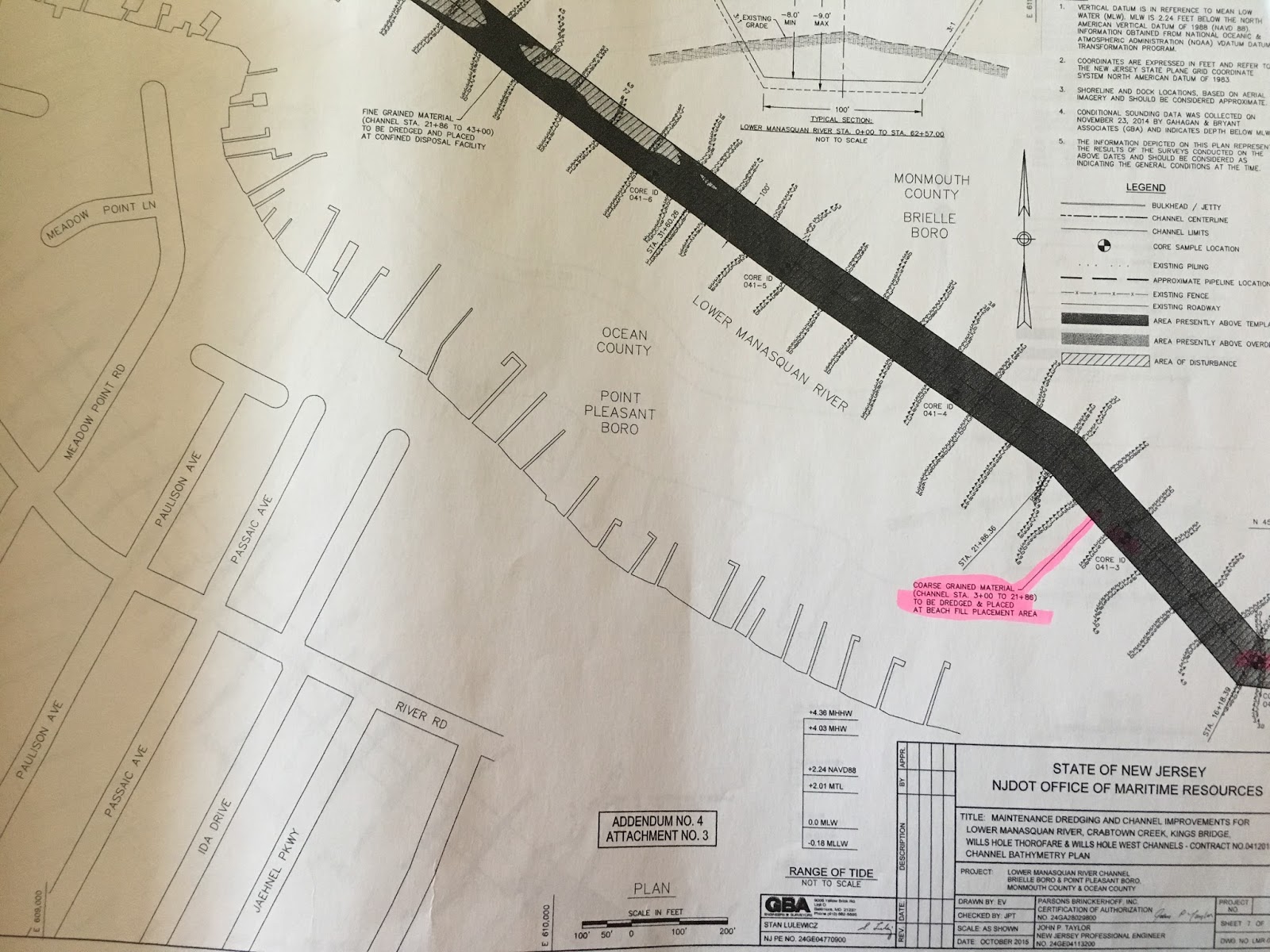
The Manasquan Inlet dredging project was permitted and put out to bid in the fall of 2015. The project permitted the dredging of the Lower Manasquan River Channel, Crabtown Creek Channel, Kings Bridge Channel, Wills Hole Thorofare, and Wills Hole West Channel. In total, over 100,000 cubic yards of material were permitted to be removed from these navigation channels.

In New Jersey, only material that is 75% sand or greater is allowed to be placed on beaches. The State however goes a step beyond this and only places material that is 90% or greater sand on bathing beaches (ie lifeguarded beaches), and 75% or greater sand material may be placed on non-bathing beaches (for example a bayside beach without a lifeguard). This is important for two reasons: 1) grain size directly relates to sand quality, which is an important consideration for those residents and visitors who come to the Jersey Shore to recreate on our world renowned sand beaches. 2) 90% sand or greater is given a “pass” from further chemical analysis because NJDEP have determined that once material reaches 90% sand in grain size, that material no longer is a risk for contamination. Therefore once this material is determined to be 90% or greater sand, no further chemical analysis is required. 

A sediment grain size analysis evaluating core samples taken at lengths along the channels was conducted by NJ Department of Transportation and reviewed by NJDEP and COA.

Roughly 57,000 cubic yards of sediment from the channels was found to be less than 90% sand - fine grained mud and silt. Gull Island is a CDF that sits smack in the middle of the river, and was designated and permitted as the receptacle for the majority of the fine grained material.

Caption: Gull Island CDF elevation map - a "bowl" for the fine grained dredge slurry (courtesy of Jersey Shore Drone)


However, approximately, 47,500 cubic yards of dredged material in specific locations of the Lower Manasquan Channel and Wills Hole Thorofare were found to contain 90% sand or greater, and  therefore suitable for placement on the beach between Manasquan Jetty and Brielle Road. This area of the beach was replenished by a larger federally overseen project in the past, however due to ocean currents and storms, is prone to erosion. Placing appropriate sand from the dredging project directly onto the beach helps to supplement and fortify the beach at this erosion prone area, and saves time, money and space for this dredging project, and future dredge and beach nourishment projects.

Caption: dredging Wills Hole Thoroughfare next to Gull Island CDF (photos courtesy of Jersey Shore Drone):

Sand that has been in the bays for several months, and even years, typically appear dark compared to sand that is found on the beach due to the presence of organic content from decaying vegetation and animals and the settling of these particles to the bay floor.  As this displaced sand dries and is exposed to sunlight and wave action, the dark organic material will weather and bleach out, and its color will change to resemble the color of sand that typically is found on New Jersey beaches.  This is similar to what we observe in typical beach replenishment projects in New Jersey: the sand that is pumped onto area beaches from the ocean and inlets is also dark when first placed on the beach, and then it lightens as it dries and is exposed to sunlight. The hydraulic dredging process may also pick up debris and trash that was buried in or sat on top of the sediment. 
Caption: 90% or greater sand with darker organic content that was pumped from Manasquan Channel and Wills Hole Thoroughfare directly onto the beach. Sunlight, rain, and wind action will eventually weather away  and wash out the darker organic matter leaving the lighter colored sand behind (photos courtesy of Jersey Shore Drone).

The site of a pipe on the beach releasing a dark colored slurry is an uncommon one for many people. However, when properly designed and vetted, these projects represent an innovative and beneficial use of material to protect properties and communities, save time and money, and perhaps contribute to less frequent large scale, federal beach nourishment projects that cost millions of dollars.

Caption: dredge slurry containing 90% or greater sand is pumped onto the Manasquan Beach, providing erosion control and protection from storms (photo courtesy Zach Lees):


It may not always be pretty -while there was some debris and trash picked up by the dredging process, the Borough of Manasquan worked in closely with NJDOT to utilize their beach rakes to remove this material, and with further coordination from the dredging contractor, ensured that larger items were captured prior to placement on the beach.


Caption: Borough of Manasquan raking the newly placed sand for any debris and shells that made it through the screens (photo courtesy Zach Lees).


Caption: Video taken by Jersey Shore Drones shows the Borough of Manasquan raking out any debris and spreading the newly placed sand out to weather out the darker organic material.


COA reviewed the permits and sediment analysis authorizing this project, and visited the beach placement site with NJ Department of Transportation (state agency in charge of state navigational channel dredging) and a representative from the Borough of Manasquan. The sediment analysis showed that each core sample was 90% or more sand, and that the dredged areas that were designated for beach placement were chosen with caution in mind, and a clear understanding of the value of New Jersey’s beautiful beaches. 


While the initial placement of this material may look a bit different than the surrounding sand, this is a temporary issue that will fade away with time, and this type of project is a model for the type of innovative beneficial use projects that can be designed to help move forward necessary navigational channel dredging, while also fortifying NJ’s beaches from storms and sea level rise.


NOTE: most all of the pictures we used of the Manasquan Channel dredging project, including the one below, are courtesy of Jersey Shore Drone, who has an incredible website that we highly recommend: http://www.jerseyshoredrone.com/2016/11/njdot-manasquan-river-dredging-11272016.html

Caption: a final shot by Jersey Shore Drone of the beach placement site. Note the "bump out" already provided by the project, in an area that was previously eroded.


[1] Credit to Jersey Shore Drone, who has done some incredible work visualizing and documenting many of these locations on the Jersey Shore. http://www.jerseyshoredrone.com/2016/04/nj-dot-manasquan-river-dredging-project.html

Thursday, August 20, 2015

Beach Day Shouldn't Turn Into a Sick Day

So far this summer, there have been a reported 62 “beach incidents” involving beach closures and/or contamination advisories due to poor water quality of popular beach areas. In order to combat this issue, Clean Ocean Action joined Senator Menendez and Congressman Pallone in announcing the re-authorization and strengthening of the BEACH Act (Beaches Environmental Assessment and Coastal Health Act).  The law is now over 15 years old and needs to be updated, strengthened, and funded.  US Senator Bob Menendez and Representative Frank Pallone are introducing bi-partisan legislation that will strengthen national water quality standards, require rapid testing methods to be used, and provide states with grants to test water quality, and public notifications when conditions are not safe. Importantly, COA is urging that the law require testing after rainstorms due to the significant pollution in runoff. Whether swimming or recreating on the water, it should not be swim at your own risk. Everyone should be informed about the water quality for their own health and safety. A beach day should not have to turn into a sick day! You can find information on NJ water quality at https://njbeaches.org. Clean Ocean Action checks this site daily, sharing closures and advisories on social media. 

Thursday, May 28, 2015

Join us in Belmar urging Governor Christie to keep fighting for the Ocean & stop ocean blasting!


Despite calls, emails, and letters, Rutgers University is still moving forward with blasting our ocean and could begin their seismic study this Monday June 1st! Tomorrow we need all hands on deck! Governor Christie will be in Belmar at 2:30 PM at Ocean Avenue and North Blvd. 

We would like to take this opportunity to thank Governor Christie for fighting ocean blasting and urge him to keep on fighting. The NJDEP has used its power under federal law to reject the study due to the negative impact on fisheries as well as marine mammals. Rutgers University has become deaf to these issues NJDEP, elected officials, and the public our raising regarding harm to marine life. 

We need Governor Christie to continue to stand strong and stop this seismic study! Will you join us? We need as many people in Belmar as possible. Rutgers could begin blasting our ocean as soon as June 1st and if allowed they can cause "any act of pursuit, torment, or annoyance" to 18,547 marine mammals!

When: Friday May 29th at 2 PM

Where: Ocean Avenue & North Blvd, Belmar, NJ 

Thank you and please spread the word!

Monday, December 2, 2013

#GivingTuesday: Have You Seen the Giving Ocean?

Video produced by Grace Hanlon, then Executive Producer, Edvantage Media

The ocean gives so much to us – free of charge, but keeping it clean, healthy, and natural is a full time job that drives Clean Ocean Action. Wouldn’t you like to give back?

Tuesday, December 3 is this year’s national day of giving.  Reacting to the consumerism that is sometimes part of the holiday season, thousands of nonprofits, companies, and people like you have come together for the second annual #GivingTuesday to make a positive contribution to society – instead of simply shopping.  

Here are some new ways to give: Recall your days of fun at the beach this year and give to the ocean: 

Unleash Your Inner Good Guy: COA Featured in The Jersey Give Back Guide
COA is thrilled to be included in the inaugural edition of The Jersey Give Back Guide, an annual, seasonal project of the Geraldine R. Dodge Foundation. A longtime supporter of Clean Ocean Action’s work, the Foundation believes everyone has the power to be a philanthropist in their own community.

The Dodge Foundation chose just fifteen organizations from the entire state that excel in collaboration, innovation, and community engagement.

Clean Ocean Action is honored to work with the Dodge Foundation on The Jersey Give Back Guide. Check out their Generosity Generator – which takes the guesswork out of donating to charity – at www.jerseygivebackguide.org.


Help COA Meet the Challenge
Each organization featured in The Jersey Give Back Guide is eligible for a $1,000 matching grant from the Geraldine R. Dodge Foundation. Help COA raise additional funds by being one of 50 supporters to give through the Guide by December 31st. Share with friends and family!

Amazon Smile
For your future holiday shopping, consider buying used books or vintage items on Amazon. When you shop using Amazon Smile, Amazon.com will make a donation to Clean Ocean Action.  Tell your friends how easy it was to shop and support the Shore on Facebook and Twitter - it even works with Amazon Prime!  Click here for more information.

Celebrate the Shore
In 2013, COA’s work focused on assisting the people, businesses, habitats, and waterways impacted by Superstorm Sandy through monthly clean-up days. Waves of Action ‘For The Shore’ program saw over 13,725 volunteers that participated in 281 projects in 70 different towns with over 120 organizations from across New York and New Jersey.  Learn more at www.ForTheShore.org.

Clean Ocean Action has been advocating for the ocean since 1984; nearly 30 years of hard work to keep the ocean wild and free of harmful industry. To learn more about COA’s ocean protection work or to make a contribution this #GivingTuesday over the phone, please call the office at (732) 872-0111.

Monday, September 16, 2013

Help Surfrider Foundation Collect Important Data on Beach Goers, Divers, Kayakers, and More!

Photo Credit: Shark River Cleanup Coalition
Your help is needed to ensure that your favorite coastal recreational areas are considered in coastal and ocean planning activities coming to the Mid-Atlantic. The Surfrider Foundation launched an online survey in July 2013 that is capturing spatial and economic data on coastal and ocean recreational use in the states of Connecticut, New York, New Jersey, Delaware, Maryland, and Virginia.

Surfrider is working in partnership with Ecotrust, Monmouth University’s Urban Coast Institute, and The Nature Conservancy, and in close coordination with the Mid-Atlantic Regional Council on the Ocean (MARCO) and the Northeast Regional Ocean Council (NROC), to survey recreational uses such as beach goers, swimmers, beach wildlife viewers, surfers, kayakers, windsurfers, and divers.

“Knowing what’s important to the recreation sector will help us make better ocean planning decisions and ensure that we maximize both sustainable economic activity and ocean health,” said Laura McKay, Director of the Virginia Coastal Zone Management Program and MARCO Management Board member.

Regional ocean planning, a process which has just begun in the Mid-Atlantic, will be a chance for all user groups to contribute to a vision of how our coastal and ocean resources should be managed. The data from this survey will be included in the Mid-Atlantic Ocean Data Portal, an online spatial data depository created by MARCO and used for regional ocean planning.

MARCO is an arrangement by the Governors of New York, New Jersey, Delaware, Maryland, and Virginia to improve the health of Mid-Atlantic ocean and coastal resources, and ensure that they continue to contribute to the economic vitality of coastal communities.

The survey will be online until the end of December 2013. To participate visit http://www.surfrider.org/mid-atlantic-recreation and enter your email address. The survey is not covering recreational fishing or boating as other studies are covering those uses. For more information please visit our regional website.


The Surfrider Foundation is a non-profit environmental organization dedicated to the protection and enjoyment of the world's oceans, waves and beaches for all people, through conservation, activism, research and education.

Thursday, June 20, 2013

Groups File Notice of Intent to Sue EPA for Failure to Protect Beachgoers from Water Pollution

Press contact: Sean Dixon, Clean Ocean Action 732-872-0111, Policy@CleanOceanAction.org
                        Tina Posterli, Riverkeeper 516-526-9371, tposterli@riverkeeper.org
                        Matt King, Heal the Bay, 310-451-1500 ext. 137, mking@healthebay.org
                        Blair Fitzgibbon, Waterkeeper Alliance, 202-503-6141, Blair@fitzgibbonmedia.com


EPA’s new water quality criteria fail to protect human health as required by the BEACH Act.
NEW YORK, N.Y. (June 20, 2013) – The Environmental Protection Agency has failed to meet its legal responsibility to adopt water quality criteria that address the health threat posed by pollution at U.S. beaches, according to a notice of intent to sue filed by a coalition of local and national organizations concerned about beach water quality. The groups are Clean Ocean Action, Hackensack Riverkeeper, Heal the Bay, Natural Resources Defense Council, NY/NJ Baykeeper, Riverkeeper and Waterkeeper Alliance.

“Too many of America’s beaches are sick – and they’re passing on their illnesses to families across the country,” said Steve Fleischli, Water Program Director at the Natural Resources Defense Council. “But EPA is not doing its job to help make sure we are safe when our families head to the beach.”

More than 180 million people visit coastal and Great Lakes beaches every year, and swimming and surfing are favorite pastimes in the United States. But beach closings due to hazardous contamination remain near all-time highs. In 2011, there were over 23,000 beach closing and health advisory days across the country. More than two-thirds of the closing and advisory days were prompted by dangerously high bacteria levels, indicating the presence of human or animal waste. The underlying culprits are generally improperly treated sewage, animal manure and contaminated stormwater runoff, which have a highly deleterious effect on water quality.

This pollution poses a significant threat to public health. Pathogens in contaminated waters can cause a wide range of diseases – including gastroenteritis, dysentery, hepatitis, and respiratory illness. However, despite these risks, EPA’s latest actions fail to protect people who choose to recreate in coastal waters. EPA has estimated that up to 3.5 million people become ill annually from contact with either overflow of overburdened sewage treatment plants during storm events, leakage from faulty infrastructure, or inappropriate sewage treatment.

“A day at the beach should never make someone sick,” said Kirsten James, Science and Policy Director for Water Quality at Heal the Bay. “EPA missed a major opportunity and a legal mandate to upgrade its recreational water quality criteria to better protect the public from the dangers of polluted water at U.S. beaches. This must be corrected.”

In 2000, Congress enacted the Beaches Environmental Assessment and Coastal Health Act (BEACH Act), requiring EPA to modernize criteria for water quality that would protect beach users from illnesses caused by pathogens, such as viruses and bacteria. EPA updated these criteria in 2012. However, EPA’s 2012 criteria are inadequate and fail to protect public health in several ways:

  • EPA’s criteria fail to protect against single day exposures to pathogens. 
  • EPA now allows water quality samples to exceed contamination levels EPA has determined are unsafe up to 10% of the time without triggering a violation. This approach could mask a serious pollution problem and expose families to an unnecessary risk of illness from recreating in local waterways.
  • EPA’s new criteria also fail to address the risk of non-gastrointestinal illnesses – such as rash and ear infections – that result from recreating in contaminated waters. The agency concluded that addressing stomach illnesses would adequately protect the public from other types of ailments.
  • EPA’s criteria permit a level of risk that would result in 36 of every 1000 beachgoers becoming ill with vomiting, nausea, or stomachaches. This level of risk is unacceptably high.

“Swimmers deserve to know that their favorite beach is clean on the day they're using it. It doesn't matter to them one bit what the average water quality was a month ago,” said Captain Bill Sheehan, the Hackensack Riverkeeper. “New Jersey discharges 23 billion gallons of sewage per year from permitted sewer overflows. Sometimes our waters are clean, sometimes they are dangerous; we are not safe unless we know which is true on a daily basis.”

“The New York-New Jersey Harbor has seen both increasing recreational use and increasing impacts from disease causing pollution,” said Deborah A. Mans, the NY/NJ Baykeeper. “We need EPA to let people know when the water is safe and to punish polluters when it is not. A monthly standard just does not protect public health.”

“EPA’s criteria is doubly flawed because it not only assumes that is acceptable for 36 of every 1000 people to contract gastro-intestinal illness by recreating in contaminated water, an unacceptably high number; it also ignores the proven risk of other health impacts, from rashes to eye and ear infections that routinely plague swimmers in our waterways,” said Phillip Musegaas, Hudson River Program Director for Riverkeeper. “People recreating in the Hudson River must be protected with strict standards, utilizing the best science to truly protect public health rather than the EPA’s status quo.”

“Science-based criteria for pathogens in recreational waters are the cornerstone of the Clean Water Act’s protections against widespread pollution by animal manure and human sewage and are essential to protecting people that swim and fish in our nation’s waterways from pathogenic illness,” said Kelly Foster, Senior Attorney for Waterkeeper Alliance. “EPA has adopted criteria that do not protect the public from disease when swimming and fishing, make it more difficult to reduce or eliminate pathogens from our recreational waters, and do not adequately inform the public about the risk they face when deciding to go to the beach. Without adequate recreational criteria, the Clean Water Act simply cannot function to adequately protect us from disease when swimming at our nation’s beaches and recreational waters.”

“The beaches, boardwalks, and bays of the nation drive billion-dollar coastal economies,” said Cindy Zipf, Executive Director of Clean Ocean Action, “having clean, safe beaches where parents, children, tourists, locals, surfers, and fishermen can enjoy a day at the beach without a day at the doctor’s is the keystone condition for these clean coastal economies. The EPA has failed in its duty to protect beachgoers using the best science, and has failed to develop a system that warns the public of health risks before they happen – not several days or weeks later.”

###

Clean Ocean Action is a coalition-based non-profit organization working to improve and protect the water quality of the marine waters off the New Jersey and New York coasts. Follow us @CleanOcean or online through www.CleanOceanAction.org

Hackensack Riverkeeper is a non-profit corporation organized to provide representation for the living resources of the Hackensack River. Hackensack Riverkeeper runs boat tours and operates a paddling center on the Hackensack River in the Meadowlands, and has its offices in Hackensack New Jersey. Captain Bill Sheehan founded Hackensack Riverkeeper fifteen years ago. www.hackensackriverkeeper.org

Heal the Bay is a non-profit organization dedicated to preserving Santa Monica Bay and all southern California coastal waters and watersheds. Progress toward the mission is achieved by effectively combining the use of science, advocacy, community outreach, and public education to create positive environmental change. For over two decades, Heal the Bay has been effective in cleaning up polluted waterbodies, including freshwater and coastal waters, to better protect the health of the public and aquatic life throughout the Los Angeles region. www.healthebay.org

The Natural Resources Defense Council (NRDC) is an international nonprofit environmental organization with more than 1.4 million members and online activists. Since 1970, our lawyers, scientists, and other environmental specialists have worked to protect the world's natural resources, public health, and the environment. NRDC has offices in New York City, Washington, D.C., Los Angeles, San Francisco, Chicago, Livingston, Montana, and Beijing. Visit us at www.nrdc.org and follow us on Twitter @NRDC.

NY/NJ Baykeeper is a non-profit corporation working to protect, preserve, and restore the ecological integrity and productivity of the New York/ New Jersey Bay. Baykeeper conducts restoration programs, especially oyster restoration, in both New York and New Jersey waters, works to acquire land for preservation and advocates for clean water throughout its coverage area – extending from Sandy Hook, New Jersey through Jamaica Bay Queens. Debbie Mans is the NY/NJ Baykeeper. http://nynjbaykeeper.org/

Riverkeeper is a membership-based, non-profit group dedicated to defending the Hudson River and its tributaries and protecting the drinking water supply of New York City and Hudson Valley residents. Through enforcement, grassroots advocacy and policy initiatives Riverkeeper has helped to establish globally recognized standards for waterway and watershed protection, and serves as the model for the growing Waterkeeper movement that includes nearly 200 Keeper programs across the country and around the globe. For more information please go to www.riverkeeper.org

Waterkeeper Alliance is an international alliance of water advocates working to patrol and protect rivers, streams, and coastlines around the world. Waterkeeper Alliance represents the interests of over 200 member watershed organizations providing a way for communities to stand up for their right to clean water. Visit us at http://www.waterkeeper.org and follow us on Twitter @Waterkeeper.