
Introduction
Manasquan Inlet – Channel Dredging, Beach Placement and Erosion Control


The site of a pipe on the beach releasing a dark
colored slurry is an uncommon one for many people. However, when properly designed and vetted, these projects represent an innovative and beneficial use of material to protect properties and communities, save time
and money, and perhaps contribute to less frequent large scale, federal beach
nourishment projects that cost millions of dollars.
Caption: dredge slurry containing 90% or greater sand is pumped onto the Manasquan Beach, providing erosion control and protection from storms (photo courtesy Zach Lees):

It may not always be pretty -while there was some debris
and trash picked up by the dredging process, the Borough of Manasquan worked in closely with NJDOT to utilize
their beach rakes to remove this material, and with further coordination from the
dredging contractor, ensured that larger items were captured prior to placement
on the beach.
Caption: Borough of Manasquan raking the newly placed sand for any debris and shells that made it through the screens (photo courtesy Zach Lees).

For over 30
years, Clean Ocean Action has worked to review, develop, and advocate for community driven dredged material management solutions. By
viewing dredged material as a resource, and emphasizing community input and
engagement, COA has reviewed and identified potential beneficial use options
for dredged material placement in many different contexts and uses. Above all,
throughout this process, COA has advocated for environmental protection, and
community involvement and support as key tenets of our position. As we
say here at Clean Ocean Action, “we know mud”.
In the last several years, we
have been monitoring what many call a “dredge crisis” – thousands of cubic
yards of dredge material are waiting to be dredged out of critical navigational channels, however, without proper planning and community engagement, and the use of innovative technologies, the disposal options for all of this dredged
material is limited. Without a plan to deal with all of this dredged material, these projects are put on hold; in some cases, for decades.
Traditionally,
Confined Disposal Facilities (CDFs) were used as both temporary and final disposal
locations for this material. CDFs are engineered structures designed to provide
storage for the soupy mix of suspended solids that are dredged out of channels and pumped into them. These
structures traditionally appear as the familiar hills and berms that you may see rising out of the
wetlands in many locations. In general, these CDFs can fill up rather
quickly, are expensive to continually maintain, and many of these CDFs have
fallen into disrepair over the years, further limiting disposal options.
Today, there
are many solutions for clean dredge material placement including beneficial use options such as using the sediment in construction fill or cover for landfills (for
contaminated dredge material the options are rightfully more limited). However,
for these uses, the soupy, watery dredged material must be “dewatered” so that it
can be transportable and useful. Most dewatering methods involve the use of a
CDF, the construction of temporary CDFs on land to dewater the material before
trucking it off, or even the use of other technologies to dewater the material in short amounts of time and on increasingly smaller footprints.
Furthermore, there are methods that can beneficially use dredged material without dewatering. Methods have been continually perfected to
perform habitat restoration projects through the creation of “living
shorelines” and the “thin layer placement” of material on a drowning marsh, and for the right types of material, can be pumped onto bayside and ocean beaches to fortify erosion areas and safeguard communities from storms.
COA recently
visited two separate locations where innovative dewatering and placement methods have
resulted in projects that provide benefits to boaters on the water, communities
on land, and beneficial material for a multitude of uses.
Manasquan Inlet – Channel Dredging, Beach Placement and Erosion Control
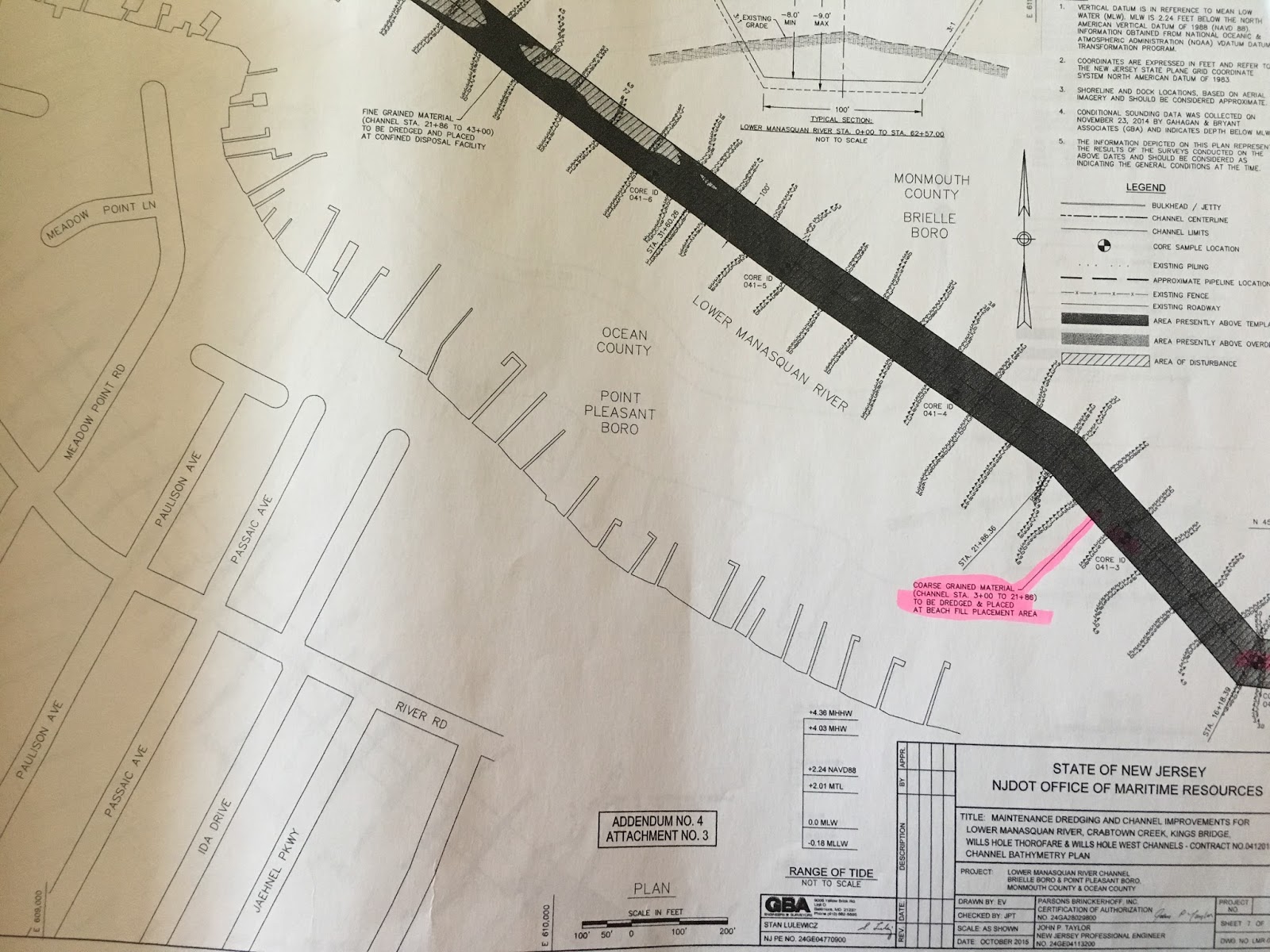
The Manasquan Inlet dredging project was permitted and put out to
bid in the fall of 2015. The project permitted the dredging of the Lower
Manasquan River Channel, Crabtown Creek Channel, Kings Bridge Channel, Wills
Hole Thorofare, and Wills Hole West Channel. In total, over 100,000 cubic yards
of material were permitted to be removed from these navigation channels.
In New Jersey, only material that is 75% sand or greater is allowed to be
placed on beaches. The State however goes a step beyond this and only places material that is 90% or greater sand on bathing beaches (ie lifeguarded beaches), and 75% or greater sand material may be placed on non-bathing beaches (for example a bayside beach without a lifeguard). This is important for two reasons: 1)
grain size directly relates to sand quality, which is an important
consideration for those residents and visitors who come to the Jersey Shore to
recreate on our world renowned sand beaches. 2) 90% sand or greater is given a
“pass” from further chemical analysis because NJDEP have determined
that once material reaches 90% sand in grain size, that material no longer is a
risk for contamination. Therefore once this material is determined to be 90% or
greater sand, no further chemical analysis is required.
A sediment grain size analysis evaluating core samples taken at lengths along the channels was conducted by NJ Department of Transportation and reviewed by NJDEP and COA.
A sediment grain size analysis evaluating core samples taken at lengths along the channels was conducted by NJ Department of Transportation and reviewed by NJDEP and COA.
Roughly 57,000 cubic yards of sediment from the channels was found to be less than 90% sand - fine grained mud and silt. Gull Island is a CDF that sits smack in the middle of the river,
and was designated and permitted as the receptacle for the majority of the fine grained material.
Caption: Gull Island CDF elevation map - a "bowl" for the fine grained dredge slurry (courtesy of Jersey Shore Drone)
Caption: Gull Island CDF elevation map - a "bowl" for the fine grained dredge slurry (courtesy of Jersey Shore Drone)

However, approximately, 47,500 cubic yards of dredged material in
specific locations of the Lower Manasquan Channel and Wills Hole Thorofare were
found to contain 90% sand or greater, and therefore suitable for placement
on the beach between Manasquan Jetty and Brielle Road. This area of the beach
was replenished by a larger federally overseen project in the past, however due
to ocean currents and storms, is prone to erosion. Placing appropriate sand from the
dredging project directly onto the beach helps to supplement and fortify the beach at this
erosion prone area, and saves time, money and space for this dredging project, and future dredge and beach
nourishment projects.
Caption: dredging Wills Hole Thoroughfare next to Gull Island CDF (photos courtesy of Jersey Shore Drone):
Caption: dredging Wills Hole Thoroughfare next to Gull Island CDF (photos courtesy of Jersey Shore Drone):


Sand that has been in the bays for several months, and even years,
typically appear dark compared to sand that is found on the beach due to the
presence of organic content from decaying vegetation and animals and the
settling of these particles to the bay floor.
As this displaced sand dries and is exposed to sunlight and wave action,
the dark organic material will weather and bleach out, and its color will
change to resemble the color of sand that typically is found on New Jersey
beaches. This is similar to what we observe in typical beach
replenishment projects in New Jersey: the sand that is pumped onto area beaches
from the ocean and inlets is also dark when first placed on the beach, and then
it lightens as it dries and is exposed to sunlight. The hydraulic dredging
process may also pick up debris and trash that was buried in or sat on top of
the sediment.
Caption: 90% or greater sand with darker organic content that was pumped from Manasquan Channel and Wills Hole Thoroughfare directly onto the beach. Sunlight, rain, and wind action will eventually weather away and wash out the darker organic matter leaving the lighter colored sand behind (photos courtesy of Jersey Shore Drone).

Caption: dredge slurry containing 90% or greater sand is pumped onto the Manasquan Beach, providing erosion control and protection from storms (photo courtesy Zach Lees):

Caption: Borough of Manasquan raking the newly placed sand for any debris and shells that made it through the screens (photo courtesy Zach Lees).

Caption: Video taken by Jersey Shore Drones shows the Borough of Manasquan raking out any debris and spreading the newly placed sand out to weather out the darker organic material.
COA reviewed the permits and sediment analysis authorizing this
project, and visited the beach placement site with NJ Department of Transportation
(state agency in charge of state navigational channel dredging) and a
representative from the Borough of Manasquan. The sediment analysis showed that each core sample was 90% or more sand, and that the dredged areas that were designated for beach placement were chosen with caution in mind, and a clear understanding of the value of New Jersey’s
beautiful beaches.
While the initial placement of this material may look a bit different than the surrounding sand, this is a temporary issue that will fade away with time, and this type of project is a model for the type of
innovative beneficial use projects that can be designed to help move forward necessary
navigational channel dredging, while also fortifying NJ’s beaches from storms and sea level rise.
NOTE: most all of the pictures we used of the Manasquan Channel dredging project, including the one below, are courtesy of Jersey Shore Drone, who has an incredible website that we highly recommend: http://www.jerseyshoredrone.com/2016/11/njdot-manasquan-river-dredging-11272016.html
NOTE: most all of the pictures we used of the Manasquan Channel dredging project, including the one below, are courtesy of Jersey Shore Drone, who has an incredible website that we highly recommend: http://www.jerseyshoredrone.com/2016/11/njdot-manasquan-river-dredging-11272016.html
Caption: a final shot by Jersey Shore Drone of the beach placement site. Note the "bump out" already provided by the project, in an area that was previously eroded.

[1]
Credit to Jersey Shore Drone, who has done some incredible work visualizing and
documenting many of these locations on the Jersey Shore. http://www.jerseyshoredrone.com/2016/04/nj-dot-manasquan-river-dredging-project.html


